Blog

Showing 1-10 of 40 articles

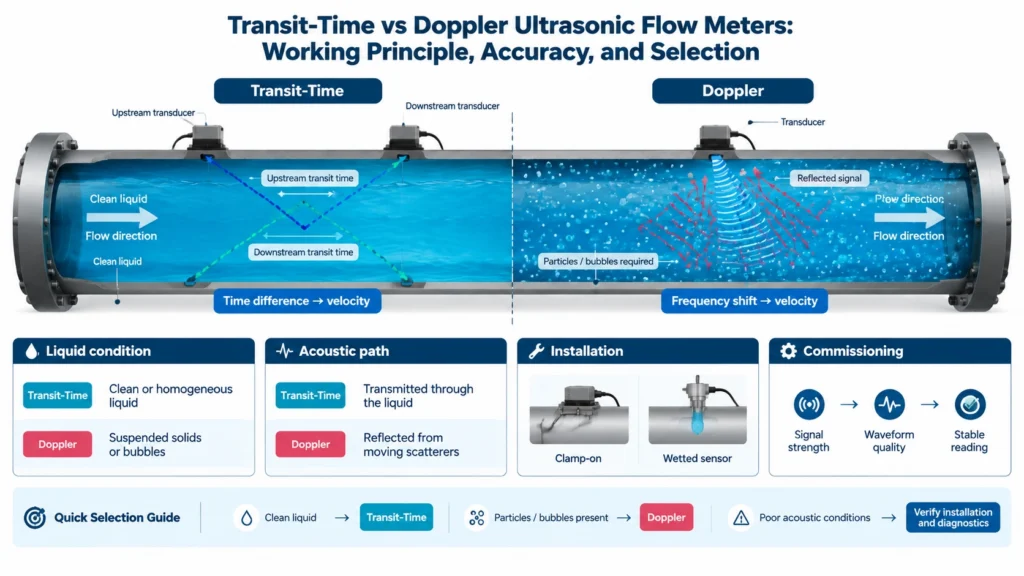
Comparison of transit-time crossed acoustic paths and Doppler reflection in an ultrasonic flow meter pipe

Published 2026-10-12

Transit-Time vs Doppler Ultrasonic Flow Meters: Working Principle, Accuracy, and Selection

Transit-time and Doppler instruments both use ultrasound, but they depend on different information in the pipe. Transit time compares acoustic travel in the upstream and downstream directions. Doppler measures a frequency shift from moving reflectors such as suspended solids or bubbles. A liquid suitable for one method may be unsuitable for the other.

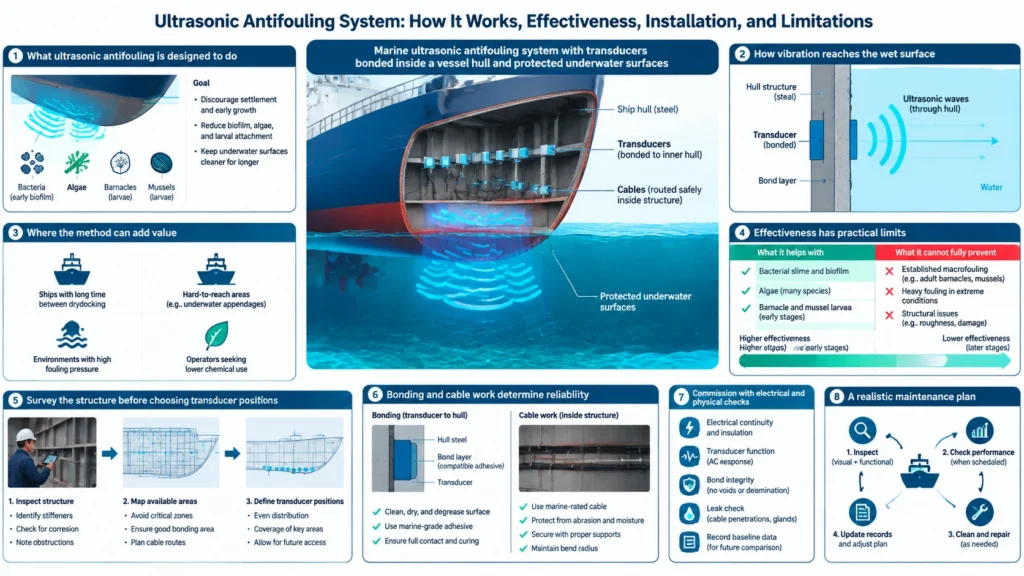
Marine ultrasonic antifouling system with transducers bonded inside a vessel hull and protected underwater surfaces

Published 2026-10-08

Ultrasonic Antifouling System: How It Works, Effectiveness, Installation, and Limitations

A marine ultrasonic antifouling system drives bonded transducers so vibration propagates through a hull, sea chest, tank or other protected structure. The objective is to make the surface less favorable for early biological attachment and growth. It is a preventive system, not a tool for instantly removing a mature layer of barnacles or heavy fouling.

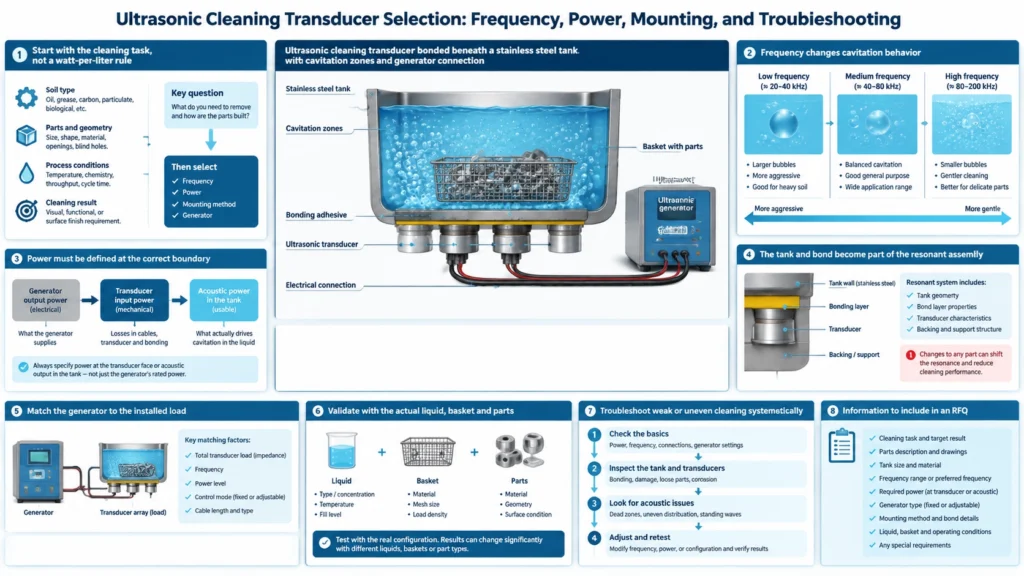
Ultrasonic cleaning transducer bonded beneath a stainless steel tank with cavitation zones and generator connection

Published 2026-09-28

Ultrasonic Cleaning Transducer Selection: Frequency, Power, Mounting, and Troubleshooting

An ultrasonic cleaning transducer converts the generator output into vibration of the tank or immersible plate. That vibration creates alternating pressure in the liquid, producing cavitation that loosens contamination. The useful result depends on the entire chain: generator, transducer, bond, tank, liquid, temperature, basket, load and cleaning cycle.

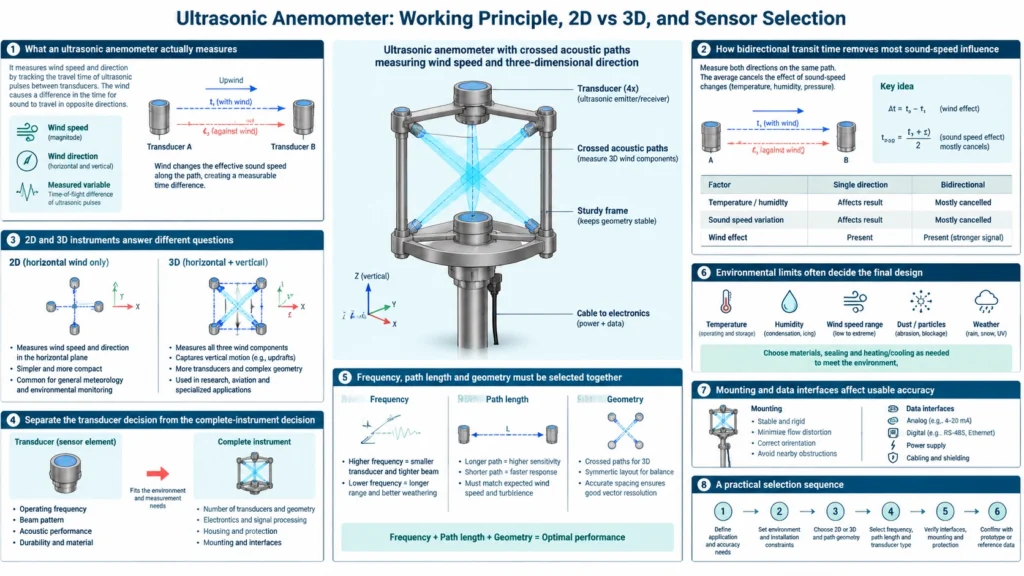
Ultrasonic anemometer with crossed acoustic paths measuring wind speed and three-dimensional direction

Published 2026-09-24

Ultrasonic Anemometer: Working Principle, 2D vs 3D, and Sensor Selection

An ultrasonic anemometer measures the effect of moving air on the travel time of an acoustic pulse. Transducers face each other across one or more known paths. A pulse traveling with the wind arrives sooner than a pulse traveling against it. The difference between the two transit times yields the wind component along that path.

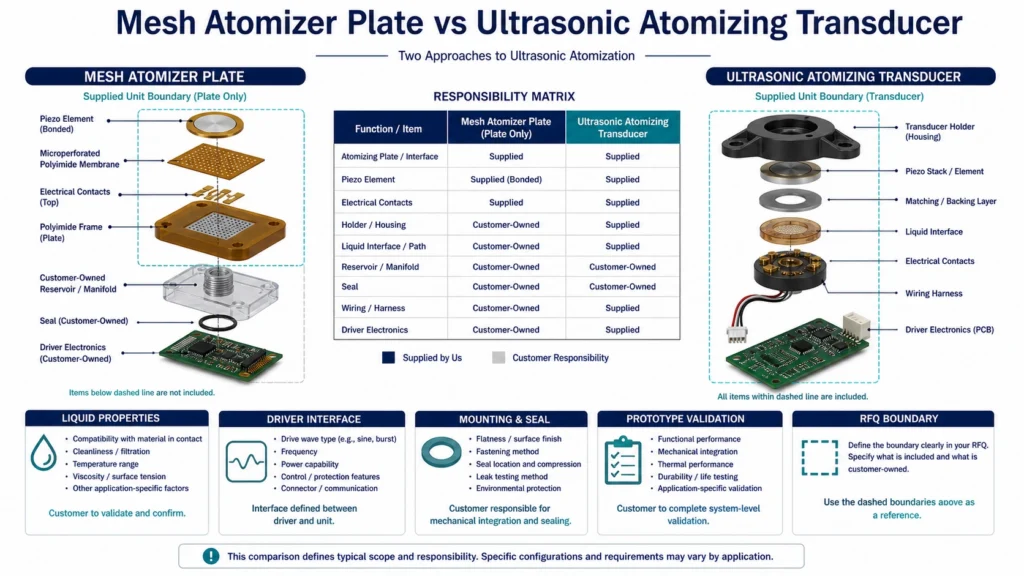
Exploded comparison of a mesh atomizer plate and a complete ultrasonic atomizing transducer with liquid path, driver and mounting interfaces

Published 2026-09-21

Ultrasonic Atomization: Mesh Atomizer Plate vs Ultrasonic Atomizing Transducer

“Ultrasonic atomizer” can describe a piezoelectric element, a bonded mesh plate, an assembled liquid-contact component, a transducer with a driver board or a complete appliance subsystem. These are different procurement boundaries. The correct choice depends less on the word atomization than on who owns the liquid feed, mechanical seal, electrical drive, control logic and final aerosol validation.

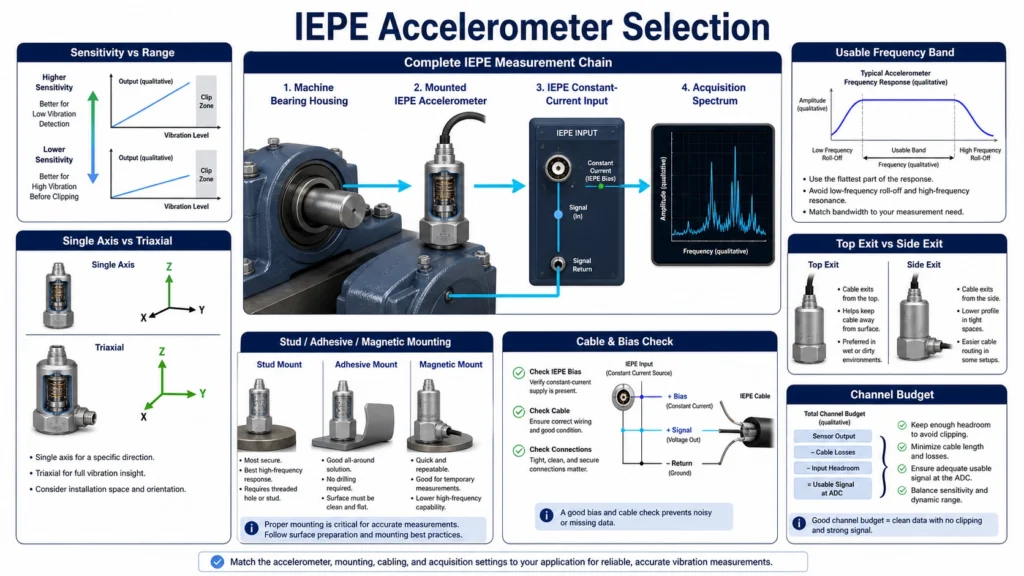
IEPE accelerometer selection diagram comparing sensitivity, axes, top and side cable exits, mounting and usable frequency response

Published 2026-09-20

IEPE Accelerometer Selection: Sensitivity, Axis, Mounting and Frequency Range

An IEPE accelerometer combines a piezoelectric sensing element with integral electronics and normally operates from a compatible constant-current input. It is well suited to dynamic vibration and shock measurements, but it does not measure true static acceleration. Selection begins with the vibration event: expected amplitude, lowest and highest useful frequency, axis directions, machine surface, temperature, cable route and data-acquisition input.

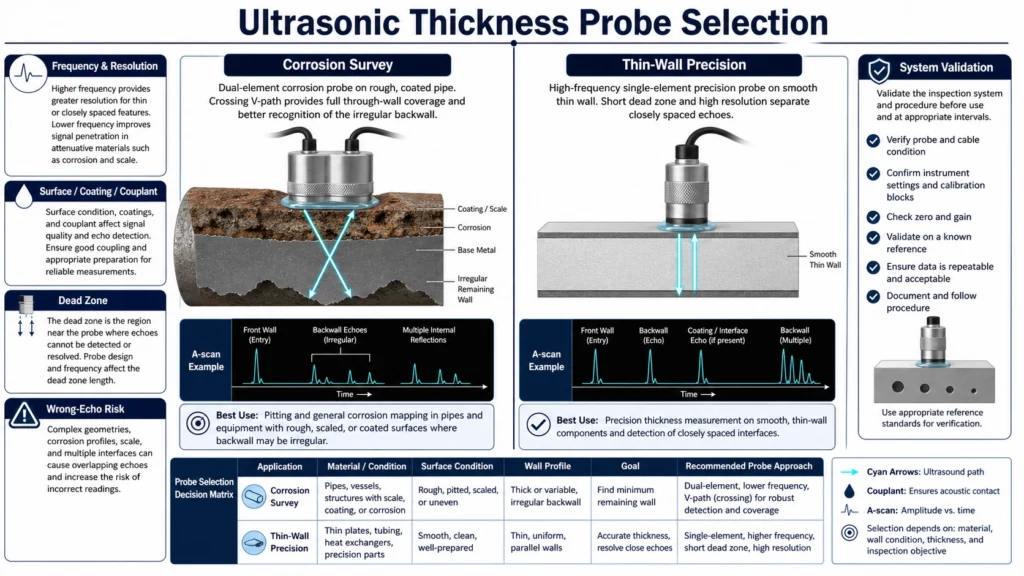
Comparison of a dual-element corrosion thickness probe and a precision thin-wall ultrasonic probe with their echo paths

Published 2026-09-17

Ultrasonic Thickness Probe Selection: Corrosion Monitoring vs Thin-Wall Precision Measurement

Corrosion monitoring asks for the minimum remaining wall in a surface that may be rough, pitted, coated or curved. Precision thin-wall measurement asks the system to separate closely spaced echoes and measure a small, usually better-defined section. Both use ultrasonic time of flight, but they impose different requirements on the transducer, instrument, calibration and scanning method.

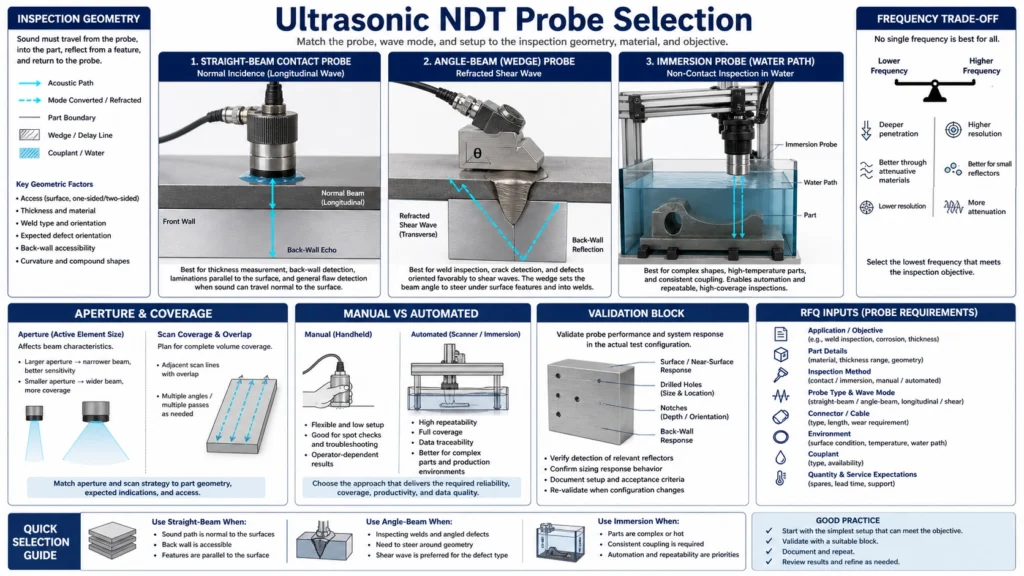
Engineering comparison of straight-beam, angle-beam and immersion ultrasonic NDT probe sound paths in test pieces

Published 2026-09-14

Ultrasonic NDT Probe Selection: Straight Beam, Angle Beam and Immersion Probes

An ultrasonic NDT probe is one part of a measurement chain that also includes the test material, couplant or water path, instrument, scan method, reference standard, calibration block and acceptance procedure. A probe that produces a clean echo on a flat steel block can still be unsuitable for a weld, a rough casting or an automated immersion line. Selection should therefore begin with the defect…

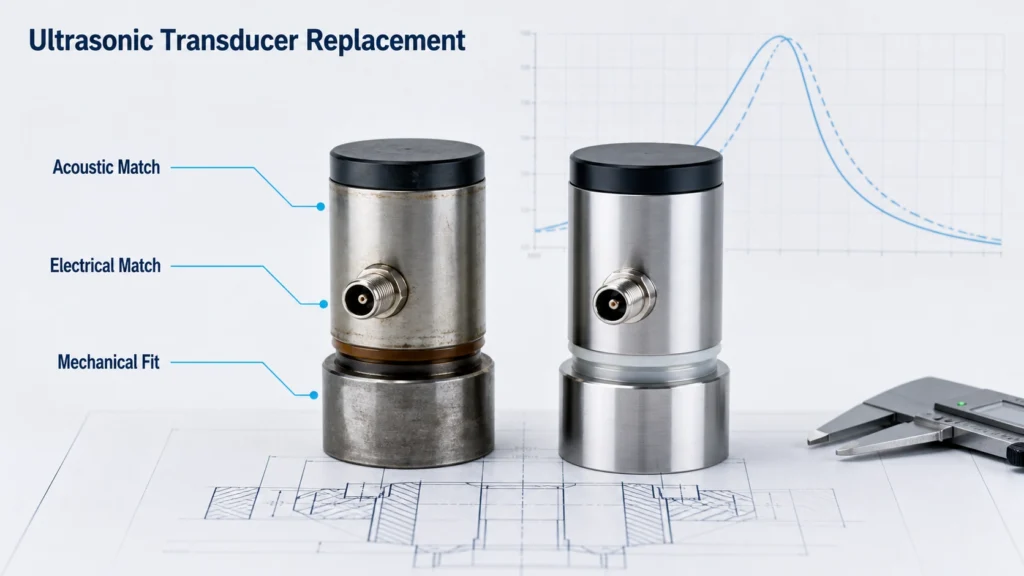
Existing and replacement ultrasonic transducers compared by acoustic, electrical and mechanical interfaces

Published 2026-09-10

Replacing an Existing Ultrasonic Transducer: What Specifications Must Match?

Two ultrasonic transducers can share a nominal frequency and outside dimensions yet differ in bandwidth, capacitance, impedance, sensitivity, ringing, beam, cable loading, housing and acoustic matching. Replacement succeeds when the new component remains compatible with the actual system, not when the label looks similar.