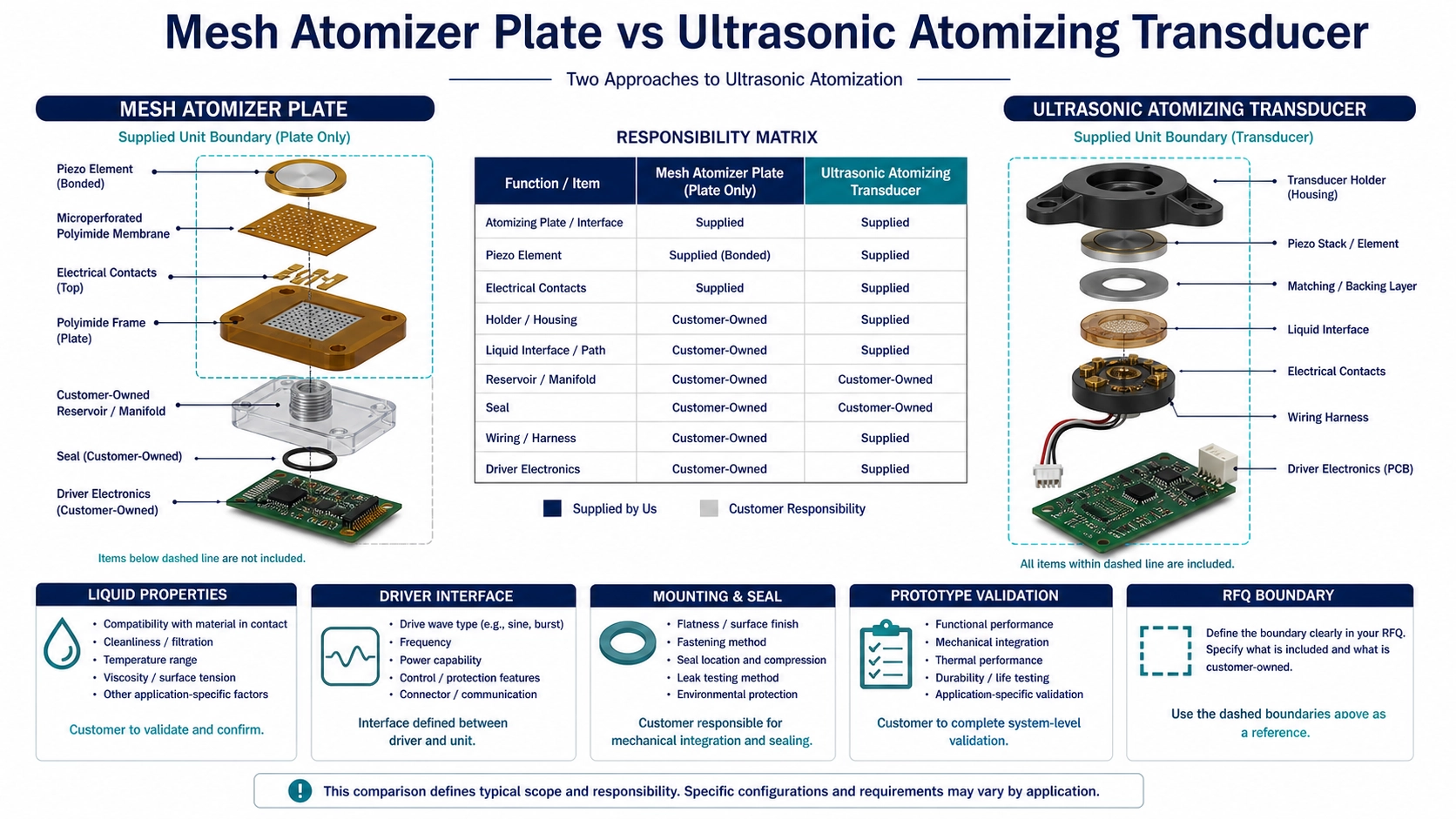
First decide what the supplier is expected to deliver
“Ultrasonic atomizer” can describe a piezoelectric element, a bonded mesh plate, an assembled liquid-contact component, a transducer with a driver board or a complete appliance subsystem. These are different procurement boundaries. The correct choice depends less on the word atomization than on who owns the liquid feed, mechanical seal, electrical drive, control logic and final aerosol validation.
A mesh atomizer plate is appropriate when the customer already has the surrounding mechanics and electronics or intends to develop them. A more complete ultrasonic atomizing transducer can reduce integration work when its mechanical interface, liquid compatibility, electrical input and control behavior match the system. Neither option can be selected from target frequency alone.
The functional chain from electricity to droplets
Electrical excitation makes the piezoelectric element deform. In a vibrating-mesh design, that motion is coupled into a perforated membrane. Liquid reaches the active mesh, and oscillation drives liquid through the apertures to form droplets. The result depends on the coupled structure: piezoelectric element, bond, mesh material and aperture pattern, liquid loading, fixture, seal and drive waveform.
PIEZO.COM’s official overview of piezoelectric ultrasonics describes the converse piezoelectric effect and atomization as an ultrasonic application. It also treats the practical device as an engineered ultrasonic solution rather than a bare ceramic specification.
Frequency is therefore a system response, not an isolated purchasing label. Bonding and clamping shift resonance relative to a free component. Liquid mass and viscosity change load. Drive voltage and waveform affect amplitude and heat. A stable bench mist with water does not prove performance with the intended formulation, orientation, duty cycle or enclosure.
What a mesh atomizer plate includes
A mesh plate normally concentrates the atomizing function in a compact component containing a vibrating structure and microperforated region. The customer may still need to provide a liquid reservoir or wick, sealing surfaces, electrical contacts, driver, housing, airflow management and control logic. The supplier drawing should define the delivered assembly and protected handling areas.
The BBAT-Q27D2 101 kHz polyimide mesh atomizer plate is an example of this component level. The published title identifies its nominal product direction and frequency; it does not establish compatibility with every liquid, flow rate or drive circuit. Confirm dimensions, mesh construction, electrical conditions and approved sample tests.
What a more complete atomizing transducer changes
A more integrated unit can combine the atomizing element with a holder, liquid interface, wiring and, in some configurations, a driver PCB. This moves part of the mechanical and electrical interface responsibility to the supplied module, but it does not remove system work. The customer still needs to manage power quality, commands, liquid delivery, ventilation, enclosure, contamination, drainage and fault behavior.
The BBAT-Q50D2 ultrasonic atomizing transducer with driver PCB represents that broader boundary. Before treating it as a drop-in solution, verify supply and control interface, board dimensions, grounding, cable, mounting, liquid-contact materials, operating orientation and what protective functions are actually included.
A responsibility matrix prevents integration gaps
| Function | Mesh plate purchase | More complete transducer purchase | Evidence needed |
|---|---|---|---|
| Piezo-mesh coupling | Usually supplied in the plate | Usually inside the module | Drawing and approved sample |
| Driver and resonance tracking | Often customer scope | May be included; confirm | Circuit interface and waveform test |
| Liquid feed and sealing | Customer system scope | Shared or module-specific | Leak and dry-run evaluation |
| Airflow and droplet transport | Customer system scope | Normally still system scope | Final enclosure test |
| Flow and droplet acceptance | Must be defined for the intended liquid and operating conditions | Agreed measurement method | |
Liquid properties and mesh cannot be separated
Viscosity, surface tension, density, dissolved solids, suspended particles and volatility influence feeding, aperture wetting, clogging and atomization. Chemical compatibility also matters for mesh, adhesive, seal and holder. A formulation can change over storage or concentration, so “water-based” is not a sufficient liquid specification.
Provide a safety data sheet where appropriate and a representative liquid sample under an agreed handling process. Define temperature, orientation, head pressure or wick condition, filtration, cleaning method and acceptable residue. Medical or therapeutic claims require a separate regulated product-development and validation process; a component description must not be treated as such a claim.
Driver PCB: included is not the same as integrated
If the driver is customer-designed, its output should be characterized under the loaded assembly, including frequency, waveform, voltage, current, startup, duty cycle and temperature. If a driver PCB is supplied, confirm input voltage range, enable or control interface, connector, grounding, electromagnetic environment, board cooling and protection behavior. Do not connect a plate to a generic ultrasonic driver solely because the nominal frequencies appear close.
The existing ultrasonic transducer circuit matching guide explains why capacitance, resonance, drive voltage and ringing must be considered together. Atomizer validation adds liquid and mechanical loading to that electrical relationship.
Different applications create different acceptance tests
- Humidification: evaluate sustained output, water quality, scaling, airflow and condensate management.
- Intermittent spraying: evaluate startup repeatability, short duty cycles, residual droplets and command timing.
- Process delivery: define liquid compatibility, flow stability, orientation and cleaning.
- Device integration: assess acoustic noise, thermal behavior, leakage, electrical safety and enclosure effects.
Flow should be measured by an agreed gravimetric or other traceable method over a defined interval. Droplet characterization requires a stated method and sampling position. Visual mist density is not a quantitative acceptance criterion.
Record liquid batch, fill level, ambient condition, operating time and preconditioning with every result. Without those controls, two apparently identical tests may compare different loads rather than different components.
Prototype in stages, then freeze interfaces
- Define liquid, target function, operating orientation and duty cycle.
- Choose the procurement boundary: plate, assembled element or module with driver.
- Confirm dimensions, liquid-contact materials, electrical interface and mounting.
- Test free electrical behavior only as an incoming baseline.
- Install in a representative liquid feed, seal and enclosure.
- Measure startup, steady output, temperature and current with the intended liquid.
- Challenge low level, bubbles, contamination, dry condition and restart as relevant.
- Approve drawings, driver revision, liquid specification and acceptance method together.
For review, provide liquid type and composition, application, desired output and its measurement method, orientation, available space, liquid-feed design, supply and control, duty cycle, environment, cleaning, quantity and the boundary you expect the supplier to deliver. Use the Deep Minds Ultrasonic engineering contact page to submit these inputs.
FAQ
Is a mesh atomizer plate a complete atomizer?
Usually not. It provides the core vibrating mesh function, while liquid feed, seal, driver, housing and control may remain in the customer system.
Can two atomizers with the same nominal frequency use the same driver?
Not safely by frequency alone. Capacitance, loaded resonance, required waveform, voltage, current and protection must be checked.
Does smaller mesh aperture always mean smaller droplets?
No single mesh dimension guarantees the final distribution. Aperture geometry, vibration, liquid properties, feed and measurement method interact.
What should be validated first with a new liquid?
Compatibility, wetting and feeding, stable startup, output, current, temperature, clogging tendency and restart behavior under representative conditions.