The liquid determines whether transit time or Doppler is viable
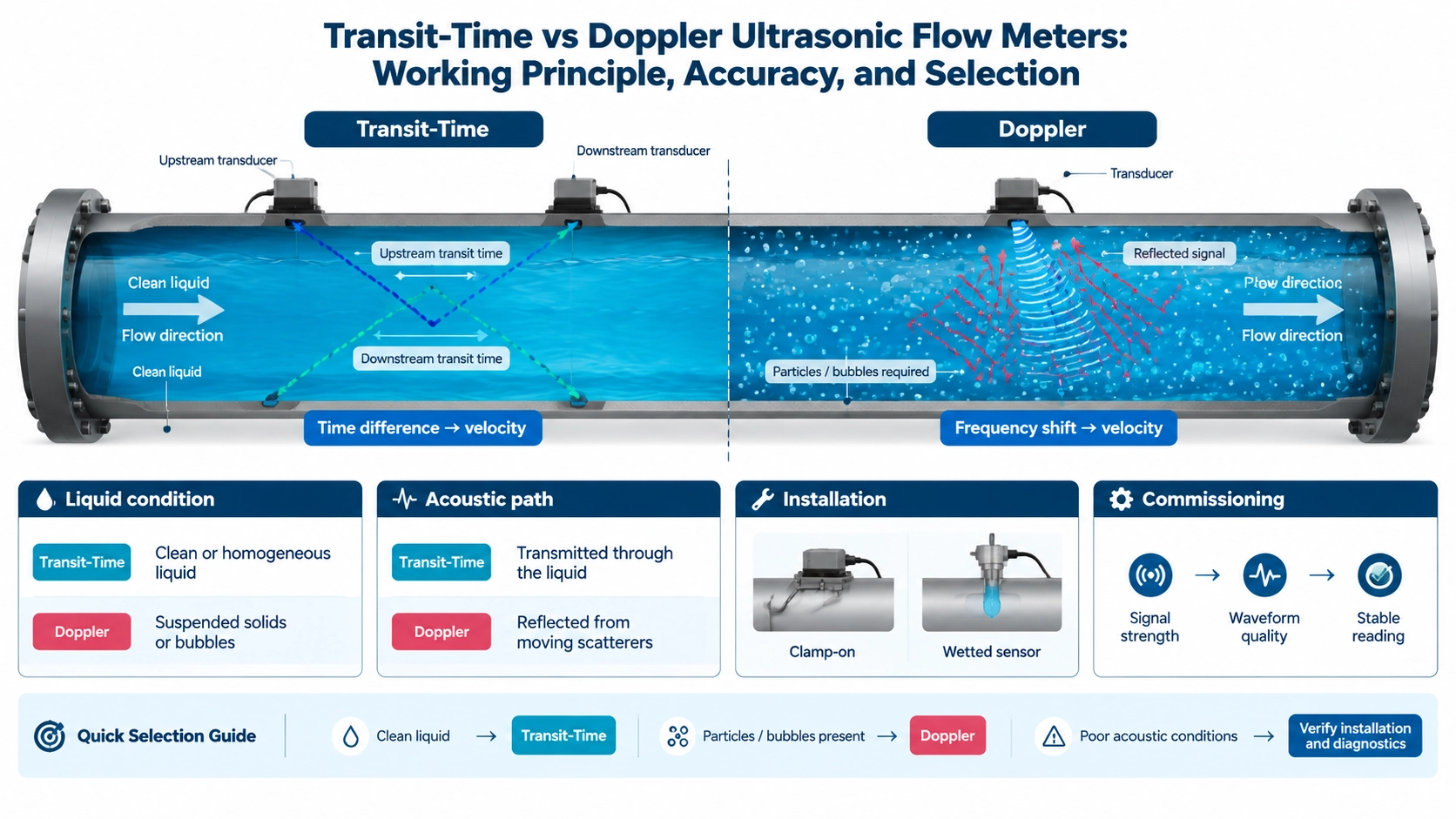
Transit-time and Doppler instruments both use ultrasound, but they depend on different information in the pipe. Transit time compares acoustic travel in the upstream and downstream directions. Doppler measures a frequency shift from moving reflectors such as suspended solids or bubbles. A liquid suitable for one method may be unsuitable for the other.
Start by describing the process fluid over its full operating range. Include solids, bubbles, viscosity, temperature, pressure, pipe material, liner, diameter, flow range and whether the pipe remains full. Choosing from pipe size alone is not enough.
How a transit-time ultrasonic flow meter works
Two transducers exchange pulses along an acoustic path across the pipe. Flow shortens the downstream transit time and lengthens the upstream time. The meter converts the difference into axial velocity and then volumetric flow using the configured pipe area and a flow-profile model.
Transit time usually performs best in relatively clean, homogeneous liquids that transmit a stable signal. Too many bubbles or solids can scatter and attenuate the pulse. However, the exact tolerance depends on path length, frequency, signal processing and the specific instrument.
How a Doppler ultrasonic flow meter works
A Doppler meter sends ultrasound into the liquid and receives energy reflected by moving particles or bubbles. Their velocity causes a frequency shift. The instrument estimates flow velocity from that shift and applies pipe geometry to calculate flow.
The method needs enough suitable reflectors moving with the liquid. Very clean water may not return a usable Doppler signal. Large bubbles, settling solids, nonuniform concentration or particles moving differently from the bulk liquid can also introduce error.
Accuracy depends on more than the sensing principle
Published accuracy assumes defined pipe, fluid, signal quality, profile and installation conditions. Actual uncertainty can include diameter and wall-thickness errors, liner data, sound-speed assumptions, transducer spacing, mounting angle, timing stability, zero offset and disturbed flow.
Transit-time meters often support higher accuracy on clean liquids when correctly installed. Doppler can enable measurement where transit-time signals fail because the liquid contains reflectors, but the relationship between reflector motion and average flow must be valid. Compare specifications only after matching the application conditions.
Clamp-on and wetted configurations change the acoustic path
Clamp-on transducers send sound through couplant, pipe wall and any liner before reaching the liquid. They avoid process penetration and can be installed without shutdown, but pipe data and surface preparation become critical. The BBUFM-DP fixed dual-path clamp-on meter illustrates a transit-time instrument designed for external installation.
Wetted transducers contact the process through a spool piece or insertion arrangement. They can provide a more controlled acoustic interface but add pressure boundary, sealing, material compatibility and maintenance requirements. Select the mechanical form together with the measurement principle.
Straight-run requirements are application dependent
Elbows, valves, pumps, reducers and partially open control valves distort velocity profiles and can introduce swirl. Straight pipe helps the meter’s sampled paths represent the average flow. Required lengths depend on the disturbance, meter path configuration, pipe size and performance target.
Do not treat a single upstream/downstream rule as universal. Follow the selected meter’s instructions and choose the best available location. Dual-path designs can improve profile sampling, but they do not make severe installation effects disappear.
Use diagnostics during commissioning
For transit time, inspect signal strength, quality, measured versus expected sound speed, transit-time ratio and zero stability. For Doppler, inspect echo level, frequency spectrum and signal stability as process conditions change. Diagnostics help distinguish a genuine flow change from loss of acoustic coupling or unsuitable liquid conditions.
Verify pipe dimensions, transducer spacing, orientation, couplant, full-pipe condition and flow direction. Compare against a reference or process balance where practical. Save the commissioned diagnostic baseline for future troubleshooting.
Selection matrix
- Relatively clean liquid: transit time is normally the first candidate.
- Liquid with persistent suspended reflectors: Doppler may be suitable.
- Intermittent bubbles or changing solids: test both signal stability and process representativeness.
- No pipe penetration allowed: evaluate clamp-on configurations.
- High accuracy requirement: prioritize controlled pipe data, profile, calibration and diagnostics.
- Partially full pipe: use a technology designed for that hydraulic condition rather than assuming a full-pipe meter will work.
ISO 12242 addresses ultrasonic transit-time meters for liquid in closed conduits and provides a standards context for specifications and verification. After choosing the principle, compare instrument formats in the clamp-on flow meter selection guide, turn the design into field steps with the installation and commissioning guide, and use the troubleshooting guide when signal quality or readings are unstable.
FAQ
Can a transit-time meter measure wastewater?
Possibly, if attenuation and scattering remain within the instrument’s capability. Wastewater varies widely, so an application test is more reliable than the fluid name alone.
Can a Doppler meter measure clean water?
It needs moving acoustic reflectors. Very clean water may not provide enough reflected energy for a stable measurement.
Which technology is more accurate?
Transit time often offers better accuracy on suitable clean liquids, but installed accuracy for either method depends on fluid, pipe, profile, setup and calibration.
Does clamp-on installation avoid all process data?
No. It still requires accurate pipe outside diameter, wall thickness, material, liner information, fluid data and a suitable full-pipe location.