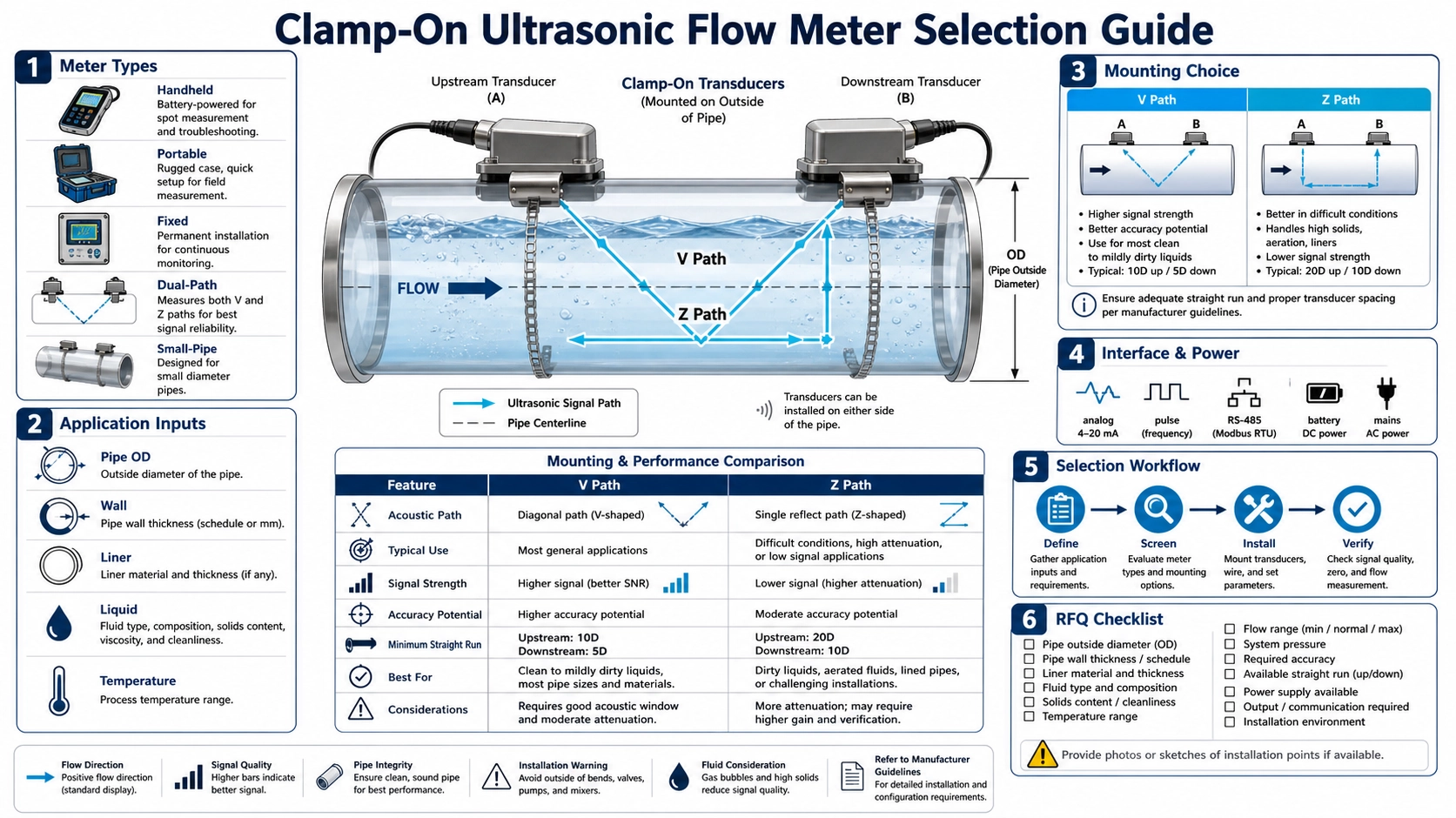
Choose the instrument around the measurement task
A clamp-on ultrasonic flow meter measures from outside the pipe, so it can be installed without cutting the line or placing a sensor in the liquid. That advantage does not make every clamp-on meter interchangeable. A technician checking ten pipes during an energy survey needs a different instrument from a plant that must send continuous flow data to a control system. The correct choice starts with the operating role, then confirms that the pipe, liquid, installation point, outputs, and verification plan support that role.
This guide compares handheld, portable, fixed, dual-path, and small-pipe configurations. It does not assign a universal accuracy to clamp-on measurement. Actual performance depends on the complete measurement chain: entered pipe dimensions, wall and liner properties, liquid acoustics, transducer selection and spacing, coupling, flow profile, signal quality, and site verification. ISO 12242:2012 describes ultrasonic transit-time meters for liquid in closed conduits and is a useful reference for the measurement principles and terminology, but a product still has to be evaluated against the requirements of the project.
What a transit-time clamp-on meter measures
A typical clamp-on transit-time system uses two transducers on the pipe wall. The instrument compares the travel time of acoustic pulses sent with and against the flow. The time difference is related to the axial velocity component along the acoustic path. The meter then combines the calculated velocity with the configured pipe geometry to report volumetric flow.
The instrument therefore needs more than the nominal pipe size. Outside diameter, wall thickness, liner thickness and material, pipe material, liquid type, and transducer arrangement affect the calculated path. A wrong wall thickness can produce a plausible signal while shifting the spacing or flow result. Before selecting a meter, confirm that these inputs are known or can be measured at the site.
Configuration comparison
| Configuration | Best fit | Primary selection questions | Typical limitation to check |
|---|---|---|---|
| Handheld | Spot checks, balancing, troubleshooting, and moving between assets | Weight, battery duration, data capture, transducer set, and field protection | Not intended to replace permanent outputs or unattended logging unless specified |
| Portable | Temporary campaigns, audits, longer logging, and reports | Logger capacity, channels, power options, case, communication, and report workflow | Temporary mounting and couplant condition must remain stable during the campaign |
| Fixed | Continuous monitoring and connection to PLC, SCADA, or energy systems | Power supply, analog and pulse outputs, RS485/Modbus, alarms, enclosure, and mounting | Requires a qualified permanent location and a commissioning record |
| Fixed dual-path | Sites that need two acoustic paths for redundancy or better representation of the velocity profile | Path geometry, channel calculation, installation space, diagnostics, and acceptance method | Two paths do not correct wrong pipe data or a fundamentally unsuitable flow profile |
| Small-pipe clamp-on | Compact pipes where conventional external transducers are difficult to position repeatably | Supported outside diameter, fixture geometry, tube material, liquid, and temperature | Mechanical fit and acoustic coupling are more sensitive to the exact tube construction |
Start with the pipe and liquid envelope
Record the minimum and maximum outside diameter rather than relying only on DN or NPS. Identify the wall material, wall schedule or measured thickness, internal liner, surface coating, corrosion condition, and available straight length. For an old pipe, a thickness gauge or documented inspection can be more reliable than a nominal schedule. The transducer must sit on sound material, not loose scale, a weld bead, or a heavily pitted surface.
Transit-time meters normally need an acoustic path through the liquid. Suspended solids, entrained gas, multiphase flow, and severe aeration can attenuate or scatter the signal. A liquid described only as “wastewater” or “chemical” is not enough for selection. State the composition, operating temperature range, expected solids or bubbles, and whether the pipe remains completely full. If transit-time transmission cannot remain stable, another measurement technology may be more appropriate.
Match the instrument to the workflow
Spot measurement and maintenance
For a maintenance team that measures one asset at a time, fast setup, a readable diagnostic screen, a manageable transducer kit, and dependable battery operation matter more than permanent I/O. The BBUFM-H handheld clamp-on flow meter is the relevant product format. Define how readings will be recorded and compared before buying; a displayed flow value without the pipe inputs, signal status, and measurement location is difficult to audit later.
Temporary logging and energy surveys
A portable campaign may remain on one pipe for hours or days. The selection should therefore include storage capacity, sampling interval, clock handling, export method, external power, battery management, and protection of temporary cables and transducers. The BBUFM-P portable clamp-on flow meter targets this type of field work, while the BBUFM-PR portable model with printer addresses workflows that require an immediate physical record. A printer does not replace electronic traceability; decide which record is authoritative.
Permanent process or utility monitoring
For continuous operation, confirm the power source, output scaling, fail-state behavior, communication protocol, totalizer handling, enclosure location, cable length, grounding, and service access. The BBUFM-F fixed clamp-on flow meter is a permanent single-path option. Where the project requires two acoustic paths, review the BBUFM-DP fixed dual-path flow meter. The acceptance plan should state how the installed result will be compared with a reference or process balance.
Do not select from accuracy alone
A catalogue accuracy statement is meaningful only with its stated conditions. For an external meter, uncertainty can also come from pipe dimensions, sound velocity assumptions, transducer positioning, couplant, and the velocity profile. Repeatability at one unchanged installation is not the same as reproducibility after removing and reinstalling the transducers. Likewise, agreement with another field meter does not establish traceability if both instruments share an unknown process bias.
Ask how the supplier defines accuracy, the pipe and flow conditions used, the usable velocity range, the required signal diagnostics, and the recommended verification method. For billing, legal metrology, or a contractual performance test, confirm whether a clamp-on system is accepted by the governing specification before treating its reading as the settlement value.
Installation constraints that affect selection
- Available straight run: locate elbows, valves, pumps, reducers, and branches. The product manual and project procedure, not a generic rule, should define the final location.
- Acoustic path: confirm the instrument supports the pipe and liquid and can calculate a suitable transducer spacing.
- Mounting method: V, Z, or another arrangement changes the path and required access. Do not choose the arrangement from pipe diameter alone.
- Surface preparation: allow safe access to remove loose paint, rust, and scale and to renew couplant where required.
- Environment: evaluate pipe temperature, ambient temperature, condensation, vibration, washdown, sunlight, hazardous-area requirements, and cable routing.
- Full-pipe condition: avoid locations where gas can collect or the pipe may run partly full.
The companion clamp-on ultrasonic flow meter installation and commissioning guide turns these constraints into a field procedure. If a site already produces weak or unstable readings, use the clamp-on flow meter troubleshooting guide before assuming that a different transmitter will solve the problem.
A procurement-ready information set
- State whether the task is a spot check, temporary logging campaign, permanent monitoring point, energy calculation input, or reference comparison.
- Provide pipe outside diameter, wall thickness, material, liner, coating, condition, and accessible length.
- Describe the liquid, temperature range, pressure, solids, bubbles, and full-pipe status.
- List expected minimum, normal, and maximum flow or velocity, including possible reverse flow.
- Define required outputs, protocol, totalizer, logging interval, storage, power, and enclosure conditions.
- Explain the upstream and downstream layout with distances to disturbances and photographs of the proposed location.
- Specify how the result will be checked and what constitutes acceptance.
FAQ
Is a portable meter more accurate than a fixed meter?
Portability does not determine accuracy. The transducer set, electronics, pipe data, installation, flow profile, signal processing, and verification conditions determine the measurement result. Compare the documented specifications and test conditions for the exact configurations.
Can one clamp-on meter measure every liquid pipe?
No. The pipe dimensions and materials must be supported, the line must provide an adequate acoustic path, and the liquid condition must permit stable transit-time transmission. Highly aerated or multiphase service may require another method.
When is a dual-path meter justified?
Use it when the project requires two paths for redundancy, diagnostics, or better representation of a non-ideal velocity profile and the installation supports the geometry. It is not a substitute for correct inputs, adequate straight run, or commissioning.
What should be supplied for a quotation?
Send the measurement role, pipe construction, liquid and temperature, flow range, site layout, required outputs and power, installation environment, verification requirement, and quantity. Photographs and a simple piping sketch reduce avoidable selection assumptions.
References and next step
For standardized terminology and the measurement framework, consult ISO 12242:2012, Measurement of fluid flow in closed conduits — Ultrasonic transit-time meters for liquid. Standards define a framework; the applicable edition, project specification, and local requirements still need to be confirmed by the responsible engineer.
To discuss a clamp-on flow measurement point with Deep Minds Ultrasonic, send the pipe outside diameter, wall and liner details, liquid, temperature, flow range, proposed location, required outputs, power, logging needs, and project quantity. The selection can then be checked against the actual measurement task rather than a model name alone.