Ultrasonic Technology Blog

Read the latest articles on ultrasonic sensors, transducers, instruments, applications and OEM/ODM solutions.

Showing 11-20 of 23 articles

Ultrasonic level meter commissioning with zero point, full level and output verification

2026-08-12

Ultrasonic Level Meter Commissioning Checklist: Zero Point, Full Level, and Output Verification

Correct mounting gives an ultrasonic level meter a usable acoustic path. Commissioning confirms that the instrument converts that path into the correct level value and sends the correct signal to the PLC, telemetry unit, display, or alarm system. A meter can be mounted neatly and still report the wrong level if the empty distance, tank height, output range, or reference point has been entered incorrectly.

Pair of clamp-on ultrasonic flow transducers aligned on a full pipe with spacing and flow direction marked

2026-08-07

Clamp-on Ultrasonic Flow Meter Installation and Commissioning Guide

A clamp-on ultrasonic flow meter can be attached without opening the pipe, but a mechanically secure installation can still produce a wrong flow result. The instrument calculates through pipe dimensions, acoustic path, transit times, and configured units. An error in wall thickness, liner data, transducer arrangement, flow direction, or output scaling can survive a neat-looking installation.

Handheld, portable, and fixed clamp-on ultrasonic flow meters beside a pipe with paired external transducers

2026-08-06

Handheld vs Portable vs Fixed Clamp-on Ultrasonic Flow Meter: How to Choose

A clamp-on ultrasonic flow meter measures from outside the pipe, so it can be installed without cutting the line or placing a sensor in the liquid. That advantage does not make every clamp-on meter interchangeable. A technician checking ten pipes during an energy survey needs a different instrument from a plant that must send continuous flow data to a control system. The correct choice starts…

Paired ultrasonic gas flow transducers across an acoustic path with pressure and temperature compensation

2026-08-03

Ultrasonic Gas Flow Transducer Selection: Frequency, Acoustic Path, Pressure, and Temperature

Ultrasonic gas flow measurement is used in residential and commercial gas meters, industrial process lines, ventilators, analyzers, combustion systems, and stack or duct monitoring. The transducers are only one part of the system. Their suitability depends on the gas, flow tube, acoustic path, pressure, temperature, frequency, electronics, calibration method, and production consistency.

Ultrasonic transducer connected to driver matching network and receiver with ringing waveform

2026-07-30

Ultrasonic Transducer Circuit Matching: Capacitance, Resonance, Drive Voltage, and Ringing

A transducer with the correct nominal frequency is not automatically compatible with an existing circuit. Transmit strength, current demand, recovery time, receive sensitivity, blind zone, noise immunity, and long-term reliability depend on the interaction between the piezoelectric element, housing, cable, driver, matching network, transmit-receive switch, protection, analog front end, and signal-processing settings.

Comparison of ultrasonic and radar level sensors above industrial tanks

2026-07-28

Ultrasonic vs Radar Level Measurement: How to Choose for Real Process Conditions

Ultrasonic and non-contact radar instruments both measure the distance from a sensor to a product surface and convert that distance into level. Their physical signals are different, however. Ultrasonic instruments use mechanical sound waves travelling through the gas space, while radar instruments use electromagnetic waves. That difference determines how each technology responds to temperature gradients, pressure, vacuum, vapor, dust, foam, condensation, internal structures, and product…

Open channel flow meter commissioning above a flume with zero point and flow verification

2026-07-26

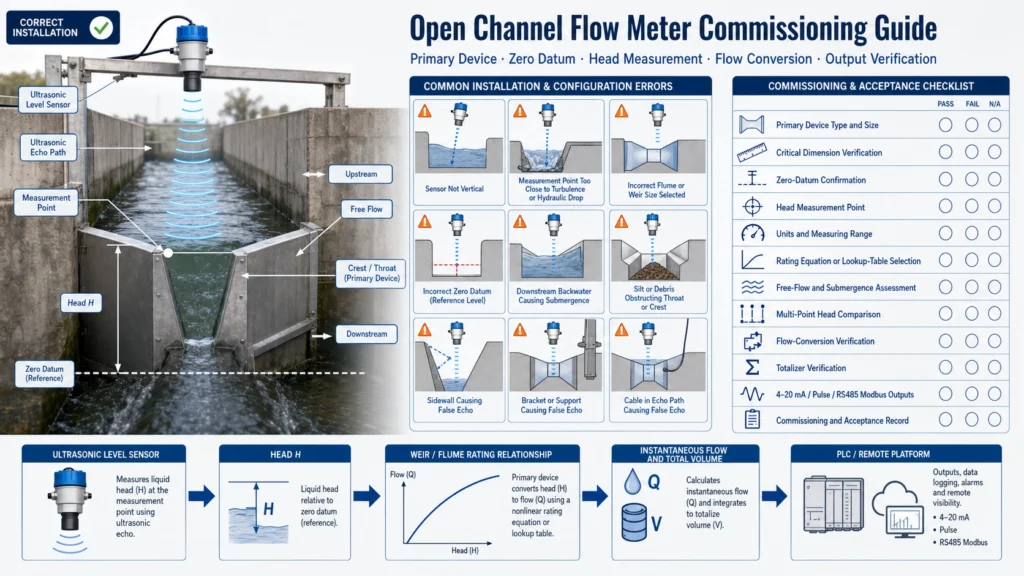
Open Channel Flow Meter Commissioning: Flume Parameters, Zero Point, and Flow Verification

An open channel flow meter does not measure flow independently. It measures liquid head at a defined location and converts that head through the rating relationship of a weir, flume, or other primary measuring device. A correct ultrasonic distance reading can therefore produce an incorrect flow value if the wrong structure, size, zero datum, measurement point, or equation has been entered.

Ultrasonic water meter flow range chart showing Q1 Q2 Q3 Q4 and R ratio

2026-07-23

Ultrasonic Water Meter Flow Ranges Explained: Q1, Q2, Q3, Q4, and R Ratio

Water meter datasheets often list a nominal diameter, a permanent flow rate, an R ratio, and several flow points. These values are not interchangeable. They define the metrological operating range and help buyers compare meters that may have the same DN size but very different low-flow capability.

Ultrasonic level meter troubleshooting for no echo false level and unstable readings

2026-07-17

Ultrasonic Level Meter Troubleshooting: No Echo, False Level, and Unstable Readings

An ultrasonic level fault may come from the sensor, the installation, the process surface, the configuration, the power supply, or the control-system mapping. Replacing the instrument before separating these possibilities often reproduces the same fault with a new unit. Begin by recording the displayed level, raw distance, echo status, output value, process condition, and the time at which the problem occurs.

Custom ultrasonic transducer RFQ checklist showing key quotation requirements including application, frequency, range, housing, electrical parameters, environment, and quantity.

2026-06-15

Custom Ultrasonic Transducer: How to Specify Requirements for Quotation

A custom ultrasonic transducer quotation requires more than a frequency value, a product photo, or a short message such as “Please quote 40kHz ultrasonic transducer.” The supplier needs to understand how the transducer will be used, what medium it will work in, what acoustic performance is required, and how it will be installed in the final product.