Measurement

Showing 1-10 of 10 articles

Category: Measurement Clear filters
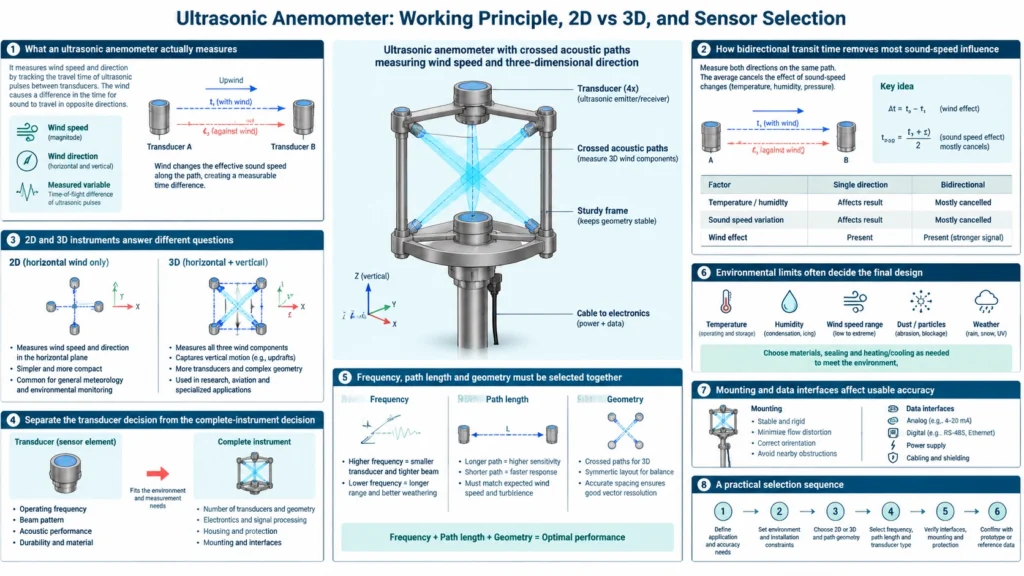
Ultrasonic anemometer with crossed acoustic paths measuring wind speed and three-dimensional direction

Published 2026-09-24

Ultrasonic Anemometer: Working Principle, 2D vs 3D, and Sensor Selection

An ultrasonic anemometer measures the effect of moving air on the travel time of an acoustic pulse. Transducers face each other across one or more known paths. A pulse traveling with the wind arrives sooner than a pulse traveling against it. The difference between the two transit times yields the wind component along that path.
Opposed ultrasonic sensors checking single and double material sheets moving through a production line

Published 2026-08-31

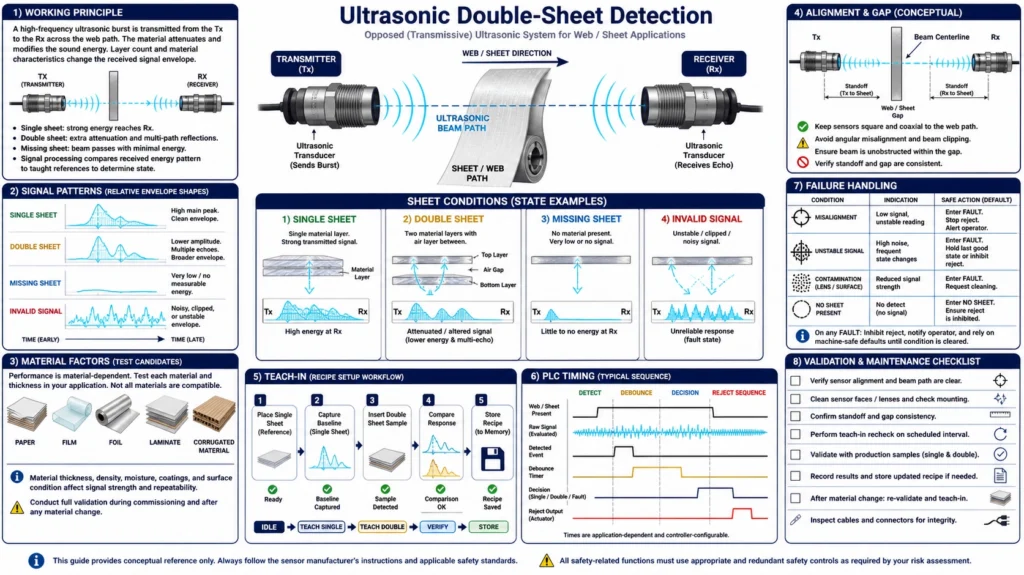
Ultrasonic Double-Sheet Detection: Working Principle, Material Limits, and Setup

An ultrasonic double-sheet sensor places a transmitter and receiver on opposite sides of the material path. The acoustic signal crossing no sheet, one sheet, and two sheets changes because each air-material interface transmits, reflects, and attenuates energy differently. The controller classifies the received response as missing sheet, single sheet, double sheet, or an invalid condition.

Ultrasonic distance sensor measuring a target through air with a temperature gradient and sound-speed compensation path

Published 2026-08-21

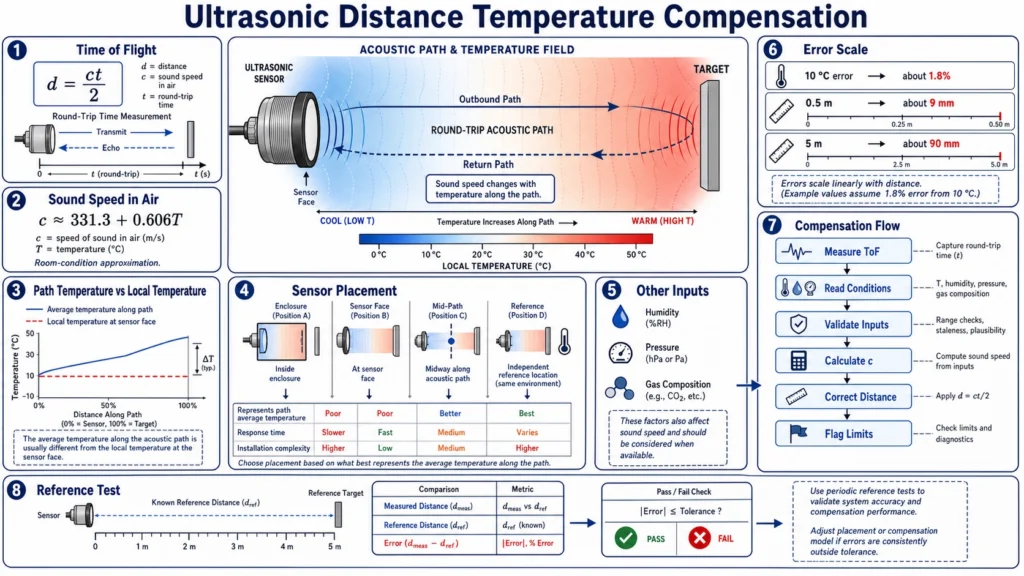
Temperature Compensation in Ultrasonic Distance Measurement: Sound Speed, Sensor Placement, and Error

An ultrasonic distance sensor measures propagation time. It converts that time into distance using an assumed or calculated speed of sound. In air, sound speed changes strongly with temperature and also depends on humidity, pressure, carbon-dioxide concentration, and gas composition. A precise timer can therefore produce a biased distance when its sound-speed model does not represent the acoustic path.

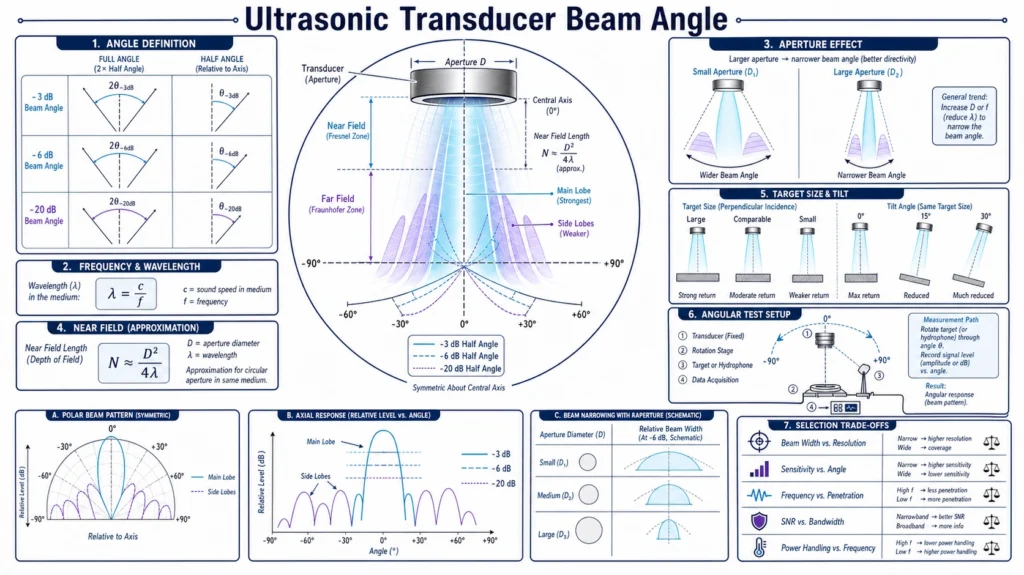
Ultrasonic transducer beam pattern showing aperture, near field, main lobe, side lobes, and angular response

Published 2026-08-17 Updated 2026-08-21

Ultrasonic Transducer Beam Angle Explained: Frequency, Aperture, Near Field, and Side Lobes

“Beam angle” is often treated as one fixed property, but a transducer does not project a cone with a hard edge. Acoustic pressure varies continuously with direction and distance. A catalogue angle may be measured between -3 dB points, -6 dB points, another threshold, or first nulls; it may describe transmit pressure, receive sensitivity, or a combined pulse-echo response. Those definitions produce different numbers for…

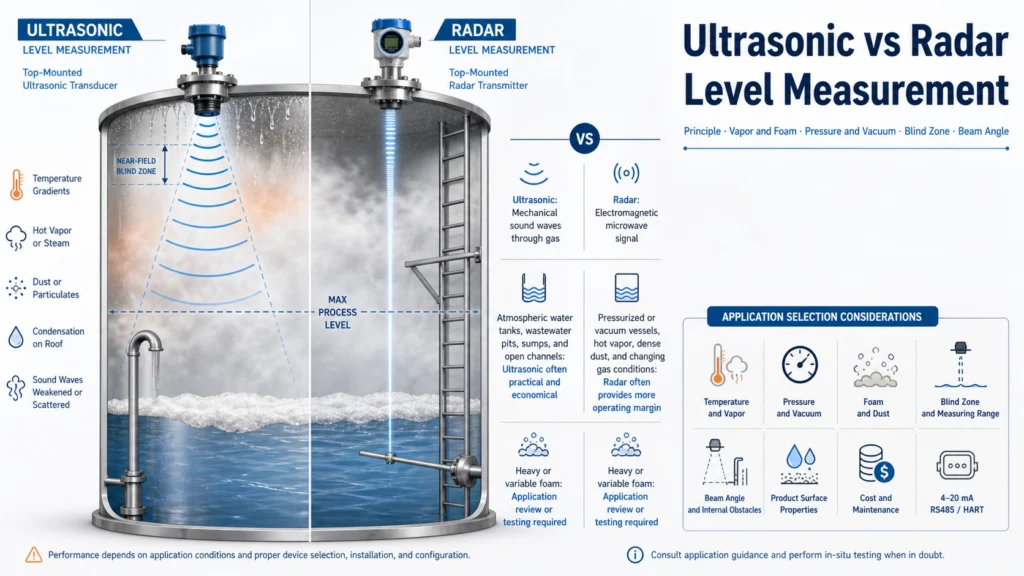
Comparison of ultrasonic and radar level sensors above industrial tanks

Published 2026-07-28 Updated 2026-08-21

Ultrasonic vs Radar Level Measurement: How to Choose for Real Process Conditions

Ultrasonic and non-contact radar instruments both measure the distance from a sensor to a product surface and convert that distance into level. Their physical signals are different, however. Ultrasonic instruments use mechanical sound waves travelling through the gas space, while radar instruments use electromagnetic waves. That difference determines how each technology responds to temperature gradients, pressure, vacuum, vapor, dust, foam, condensation, internal structures, and product…

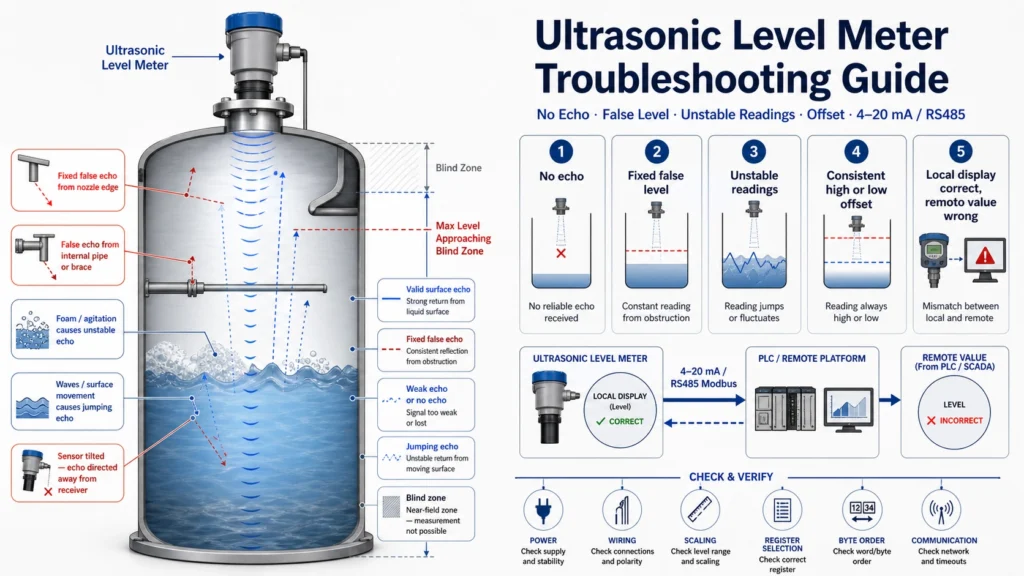
Ultrasonic level meter troubleshooting for no echo false level and unstable readings

Published 2026-07-17 Updated 2026-08-21

Ultrasonic Level Meter Troubleshooting: No Echo, False Level, and Unstable Readings

An ultrasonic level fault may come from the sensor, the installation, the process surface, the configuration, the power supply, or the control-system mapping. Replacing the instrument before separating these possibilities often reproduces the same fault with a new unit. Begin by recording the displayed level, raw distance, echo status, output value, process condition, and the time at which the problem occurs.

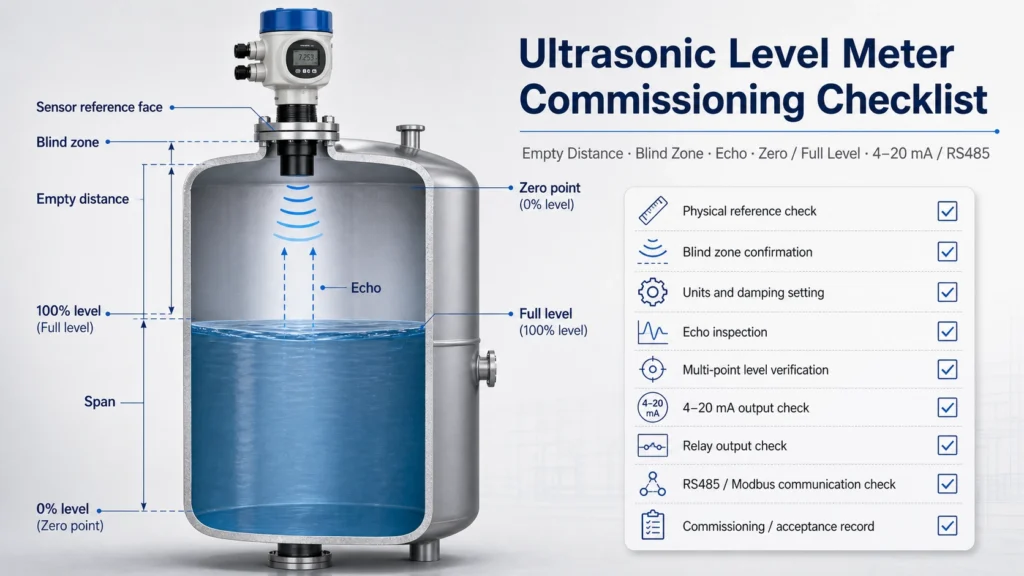
Ultrasonic level meter commissioning with zero point, full level and output verification

Published 2026-07-17 Updated 2026-08-21

Ultrasonic Level Meter Commissioning Checklist: Zero Point, Full Level, and Output Verification

Correct mounting gives an ultrasonic level meter a usable acoustic path. Commissioning confirms that the instrument converts that path into the correct level value and sends the correct signal to the PLC, telemetry unit, display, or alarm system. A meter can be mounted neatly and still report the wrong level if the empty distance, tank height, output range, or reference point has been entered incorrectly.

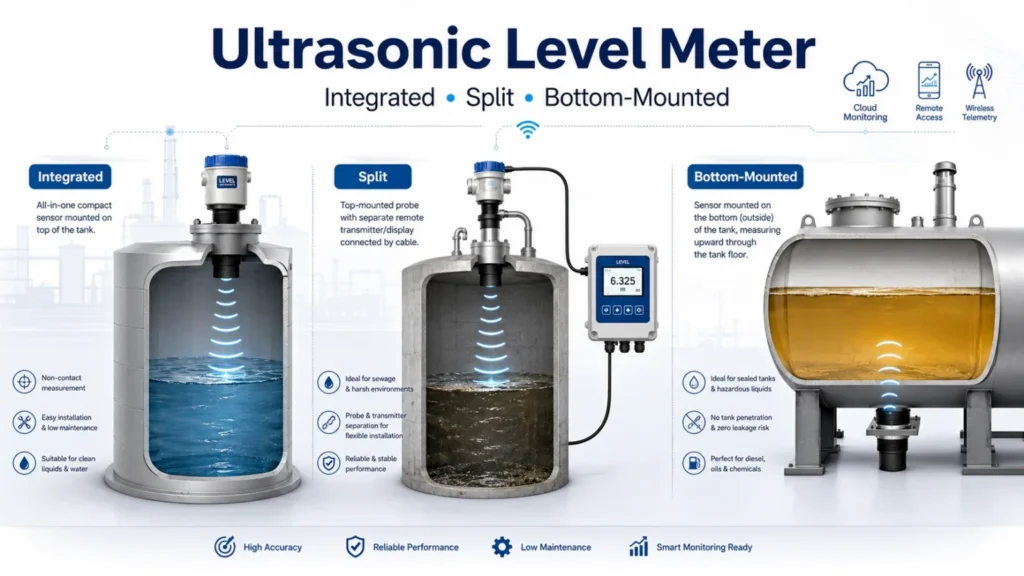
Ultrasonic level meter comparison showing integrated, split, and bottom-mounted types

Published 2026-05-26 Updated 2026-08-21

Ultrasonic Level Meter: Integrated, Split, and Bottom-Mounted Types Explained

An ultrasonic level meter is a level measurement device that uses ultrasonic sound waves to measure the distance between the sensor and the surface of a liquid or solid material. In many tank and process applications, this distance is then converted into a level value based on the tank height or installation position.

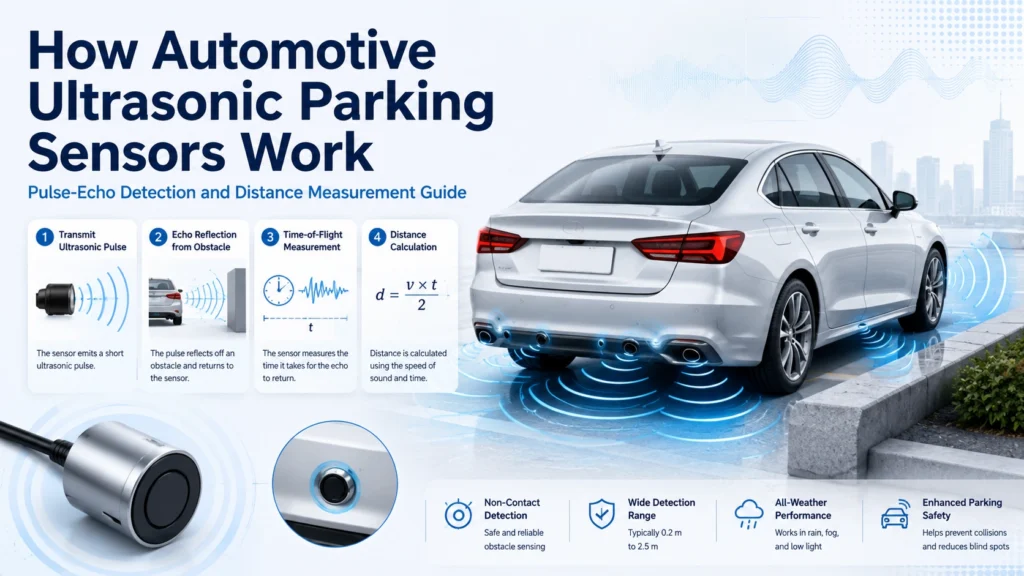
Car reversing with ultrasonic parking sensors detecting a curb and nearby obstacles behind the vehicle

Published 2026-04-16 Updated 2026-08-21

How Automotive Ultrasonic Parking Sensors Work

Automotive ultrasonic parking sensors help drivers detect nearby obstacles when reversing or maneuvering in tight spaces. They are widely used in modern parking assistance systems because they provide fast and reliable short-range obstacle detection. By sending ultrasonic waves and analyzing the reflected signals, the system can estimate the distance between the vehicle and nearby objects and warn the driver in real time.

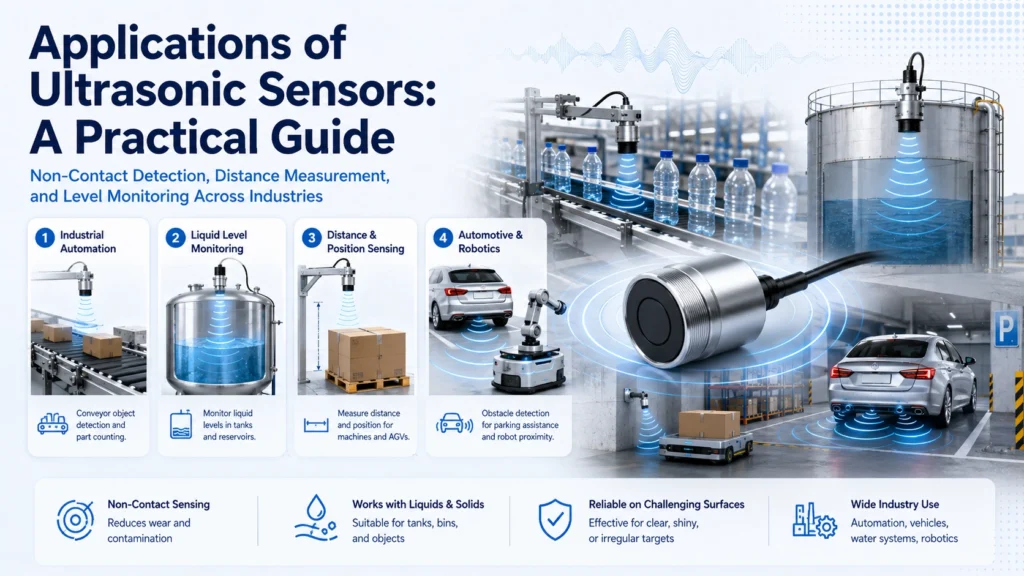
Industrial liquid level measurement as one of the applications of ultrasonic sensors

Published 2026-04-02 Updated 2026-09-30

Various Applications of Ultrasonic Sensors

An ultrasonic sensor is a non-contact sensing device that emits high-frequency sound waves and measures the time it takes for the reflected echo to return after reaching a target object. This method is commonly known as time-of-flight measurement.