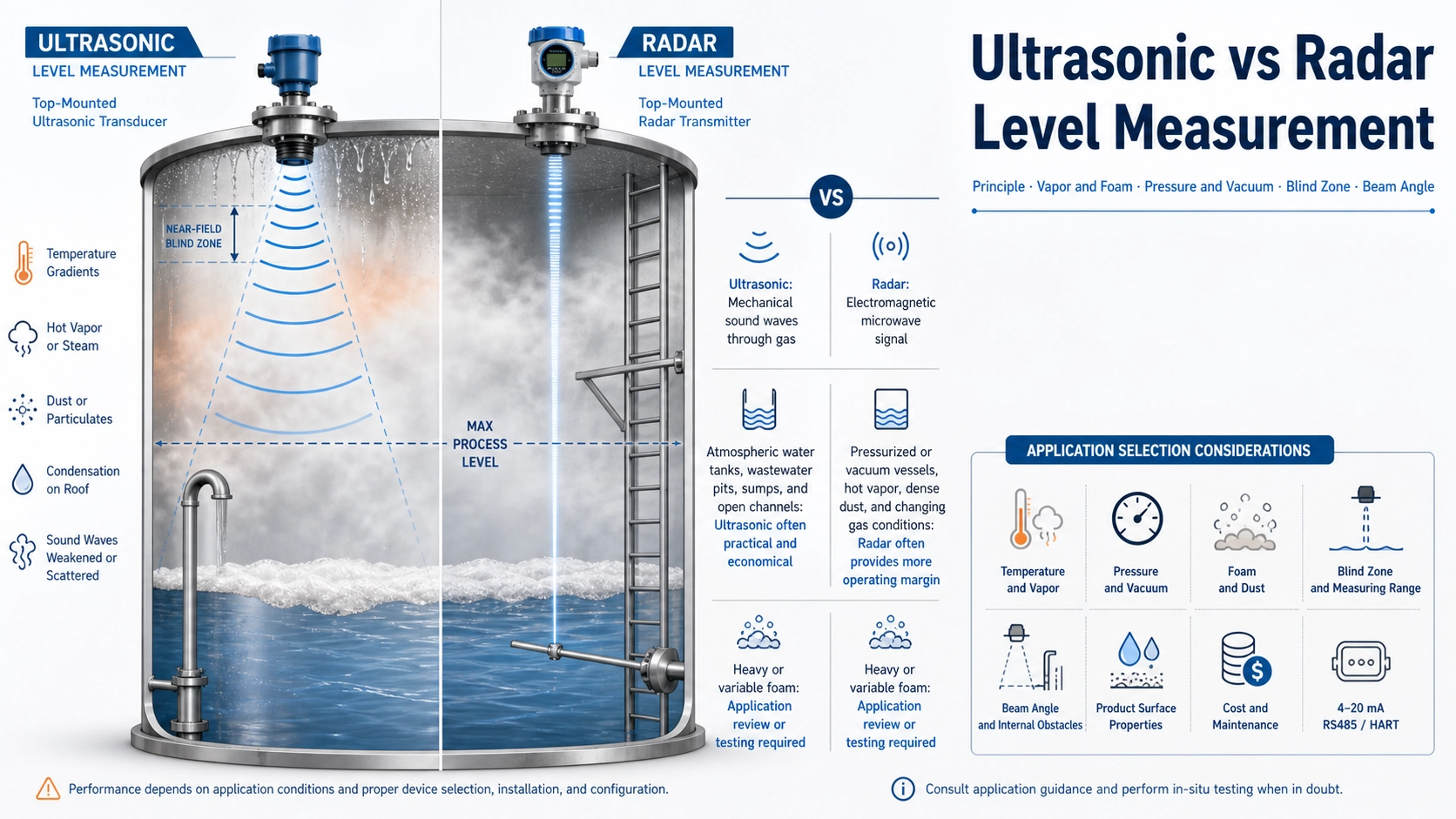
The correct choice depends on the vapor space and the process, not only the tank height
Ultrasonic and non-contact radar instruments both measure the distance from a sensor to a product surface and convert that distance into level. Their physical signals are different, however. Ultrasonic instruments use mechanical sound waves travelling through the gas space, while radar instruments use electromagnetic waves. That difference determines how each technology responds to temperature gradients, pressure, vacuum, vapor, dust, foam, condensation, internal structures, and product properties.
Ultrasonic measurement remains a practical and economical choice for many water, wastewater, open tank, sump, and standard storage applications. Radar generally provides more operating margin when the vapor space or process conditions are severe. The purpose of selection is not to declare one technology universally better, but to match the measurement principle to the real process.
How the two principles differ
| Item | Ultrasonic | Non-contact radar |
|---|---|---|
| Signal | Mechanical sound pulse through gas | Electromagnetic microwave signal |
| Main time-of-flight dependency | Speed of sound in the gas space | Propagation of electromagnetic waves |
| Typical strength | Cost-effective standard non-contact measurement | Greater tolerance of changing vapor-space conditions |
| Typical limitation | Sound attenuation, temperature gradients, foam, vapor, dust | Weak dielectric reflection, severe buildup, geometry, inappropriate antenna selection |
Both technologies still require correct mounting, a suitable beam path, adequate clearance near the sensor, and appropriate signal processing. Radar is not immune to every problem, and ultrasonic is not limited to laboratory-clean tanks.
Temperature, vapor, pressure, and vacuum
The speed of sound changes with gas temperature and composition. Most ultrasonic level meters use temperature compensation, but a sensor-mounted temperature element cannot always represent a strongly stratified vapor space. Hot vapor layers, rapid heating, gas composition changes, or condensation can introduce additional error or weaken the echo.
Non-contact radar is generally much less sensitive to gas temperature and composition. It is also the preferred option for many pressurized vessels and vacuum applications, subject to the selected instrument’s pressure, temperature, hazardous-area, and process-connection ratings. Standard ultrasonic instruments are commonly intended for atmospheric or lightly vented vessels and should not be assumed suitable for pressure or vacuum service.
Foam, dust, steam, and condensation
Foam can absorb or scatter ultrasonic energy. A thin, wet foam may return a signal from the foam surface, while thick, dry, or highly aerated foam may produce a weak or unstable echo. Radar performance also depends on foam type and microwave frequency; radar may see through some foam or reflect from it, but this must be validated for the product.
Dense dust and heavy vapor often reduce ultrasonic signal strength because sound must travel through the disturbed gas space. Radar usually retains more margin in these conditions, especially with a narrow, focused beam. Condensation can affect either technology if droplets or buildup accumulate on the sensor face or antenna. Installation angle, purge or protective accessories, antenna material, and maintenance access remain important.
Surface type and product properties
Ultrasonic instruments need an acoustic surface that returns enough sound energy. Stable water and many liquids are straightforward. Sloped solids, fluffy powders, very soft surfaces, and rapidly changing material angles can create weak or redirected echoes.
Radar reflection depends strongly on the product’s dielectric behavior and the selected frequency and antenna. Many modern radar instruments can measure low-dielectric products, but very weak reflections, extreme buildup, or difficult geometry may still require engineering review. For interface measurement, guided-wave radar or another principle may be more suitable than either basic ultrasonic or non-contact radar.
Blind zone, range, and useable vessel volume
Ultrasonic transducers require recovery time after transmission, creating a near-field blind zone. The highest process level must remain outside this zone. Radar instruments also have near-field constraints, but many modern high-frequency devices can measure closer to the antenna and use a narrower beam. This can increase usable volume in short vessels or tanks with limited headroom.
Maximum range should never be selected by the brochure value alone. Range margin decreases with weak targets, foam, dust, vapor, turbulence, and poor mounting. For both technologies, confirm the guaranteed or recommended range under actual process conditions.
Beam angle and internal obstacles
Large nozzles, ladders, agitators, heating coils, braces, inlet pipes, and narrow vessel walls can generate false echoes. Ultrasonic beam width depends on transducer diameter, frequency, and design. Compact radar sensors operating at higher microwave frequencies often provide a narrower beam, which can help avoid internal structures.
A narrow beam does not eliminate the need for a good mounting position. The antenna must still be aimed at the intended surface, kept clear of filling streams, and installed according to nozzle requirements. Use the instrument’s echo curve and false-signal mapping only after checking the physical layout.
Cost, maintenance, and system complexity
For standard atmospheric water tanks, open channels, sumps, and wastewater pits, ultrasonic instruments can offer a favorable cost-to-performance ratio and familiar commissioning. Radar prices have fallen, but process-grade housings, antennas, approvals, pressure connections, and diagnostics can still increase project cost.
Maintenance depends more on the process than on the technology label. An ultrasonic face in a condensing environment may require cleaning. A radar antenna exposed to sticky product may also require inspection. Consider access, buildup, cable routing, housing material, ingress protection, hazardous-area approval, output, and lifecycle support.
Practical selection matrix
| Application condition | Typical starting point | Reason |
|---|---|---|
| Atmospheric clean-water tank | Ultrasonic or radar | Both can work; compare range, headroom, output, and cost |
| Open wastewater pit with moderate vapor | Ultrasonic often practical | Non-contact, accessible, cost-effective if echo remains stable |
| Pressurized or vacuum vessel | Radar | More suitable physical principle and process-rated designs |
| Dense dust or hot vapor space | Radar | Generally less affected by gas-space attenuation and gradients |
| Heavy or variable foam | Application test required | Both technologies can respond differently to foam structure |
| Short tank with very small headroom | Radar often preferred | Smaller near-field and focused beam may preserve vessel volume |
| Simple outdoor water storage with budget constraint | Ultrasonic often preferred | Good value when atmospheric and acoustic conditions are suitable |
Information to provide before selection
- Liquid, slurry, powder, granules, or other product
- Tank height, diameter, nozzle size, and internal structures
- Minimum and maximum level, including overfill margin
- Pressure, vacuum, temperature, and vapor-space conditions
- Foam, dust, steam, condensation, turbulence, and buildup
- Required accuracy, response time, and alarm function
- 4–20mA, HART, RS485, relay, wireless, or other interface
- Hazardous-area, sanitary, chemical compatibility, and IP requirements
For standard ultrasonic architectures, see our integrated, split, and bottom-mounted level meter guide. For installation acceptance after selection, use our ultrasonic level meter commissioning checklist.
Manufacturer references from VEGA, Endress+Hauser, and other instrument suppliers show why the process environment must be evaluated rather than relying on one generic comparison.
FAQ
Is radar always more accurate than ultrasonic?
No. Accuracy depends on the model, range, mounting, target, process, and commissioning. Radar often provides more stability under difficult vapor-space conditions, while ultrasonic can be fully adequate in standard atmospheric service.
Can radar measure through foam?
Sometimes, but not universally. The result depends on foam density, moisture, thickness, product dielectric properties, radar frequency, and signal processing. Testing or application review is recommended.
When should ultrasonic still be selected?
Ultrasonic remains attractive for many clean or moderately difficult atmospheric tanks, sumps, open channels, water and wastewater applications where a clear acoustic path and sufficient headroom are available.