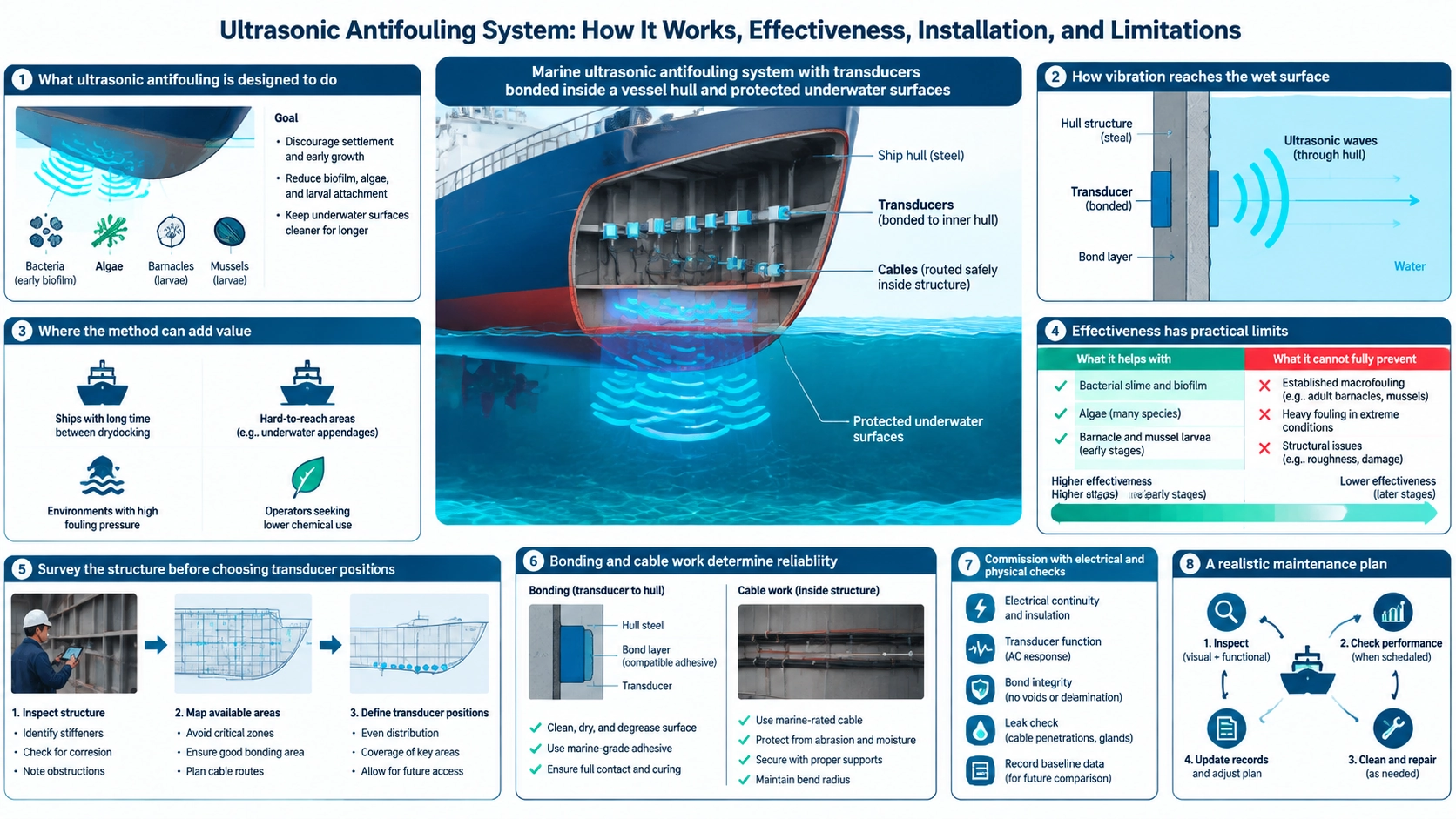
What ultrasonic antifouling is designed to do
A marine ultrasonic antifouling system drives bonded transducers so vibration propagates through a hull, sea chest, tank or other protected structure. The objective is to make the surface less favorable for early biological attachment and growth. It is a preventive system, not a tool for instantly removing a mature layer of barnacles or heavy fouling.
Results depend on the structure, installation, operating time, vessel activity, water conditions and organisms present. Treat claims of universal or permanent protection cautiously. The correct engineering question is whether the system can reduce fouling pressure and maintenance for the specified surfaces under the vessel’s actual service profile.
How vibration reaches the wet surface
The controller excites piezoelectric transducers bonded to the dry side of the structure. Their vibration couples into the material and spreads as structural waves. Multiple operating frequencies or swept excitation may be used to avoid relying on one narrow response. The underwater surface experiences small mechanical motion rather than a high-power cleaning event in the surrounding water.
Transmission changes at stiffeners, bulkheads, bonded cores, joints and changes of material. A fiberglass laminate, solid metal plate and sandwich construction do not distribute vibration in the same way. The complete BBUAF ultrasonic marine antifouling system must therefore be configured around the protected structure, not selected from vessel length alone.
Where the method can add value
Candidate areas include hull zones, sea chests, box coolers, strainers, tanks and other submerged structures where transducers can be coupled to a suitable dry surface. The method is attractive where coatings are difficult to renew, access is limited or reduced cleaning frequency has operational value.
Ultrasound may complement coatings, regular inspection and mechanical cleaning. It should not automatically replace corrosion protection, legally required coatings or maintenance procedures. The best strategy can be hybrid: use each method for the failure mode it controls.
Effectiveness has practical limits
Existing heavy growth blocks evaluation and should be removed before commissioning. Thick coatings, delamination, air gaps and poorly bonded transducers reduce transfer. Large or segmented structures need several acoustic zones. Shadowed appendages may receive little useful vibration even when the nearby hull performs well.
Water temperature, salinity, nutrient level, time at berth and local species affect fouling rate. A result from an active vessel in one harbor cannot be transferred directly to a stationary vessel elsewhere. Define success as a measurable reduction in coverage, growth rate or cleaning effort over a stated inspection interval.
Survey the structure before choosing transducer positions
Map the surfaces to protect, hull material and thickness, frames, bulkheads, tanks, insulation, coatings and available dry access. Divide the structure into zones separated by major discontinuities. Place transducers on sound, prepared material where vibration can enter the intended zone.
Avoid assuming that one transducer covers a fixed number of square meters under every condition. Coverage depends on geometry and attenuation. For complex structures, use trial measurements or staged installation to confirm propagation before finalizing all locations.
Bonding and cable work determine reliability
Remove contaminants and weak coating from the bonding area according to the approved process. Prepare the surface, control adhesive thickness and hold the transducer in position for the complete cure. Bonding over an unknown coating or leaving voids can create heat and poor transfer.
Route cables away from heat, sharp edges, high-current conductors and locations vulnerable to water or mechanical damage. Seal penetrations and provide strain relief. The controller needs the specified supply, ventilation and environmental protection. Label each channel so future inspection can associate a transducer with its protected zone.
Commission with electrical and physical checks
Record channel current, operating state and any fault diagnostics after installation. Confirm that each transducer is active and that the controller does not enter repeated protection. Abnormal heating, unstable current or noise may indicate poor bonding, wiring problems or an unsuitable load.
Photograph or map the underwater surfaces at the start. Inspect at planned intervals and compare protected and reference areas under similar conditions. A clear baseline is more useful than judging performance from memory at the next haul-out.
A realistic maintenance plan
Keep the system energized according to its operating instructions when fouling exposure exists. Periodically inspect controller status, connections, cable condition and transducer bonds. After structural repair, coating work or impact, verify the affected acoustic zone again.
Continue normal inspection of corrosion, anodes, coatings, intakes and appendages. Ultrasound addresses biofouling risk; it does not certify the integrity of the vessel or replace safety-critical maintenance.
The International Maritime Organization’s biofouling guidance places prevention within a vessel-specific management plan supported by inspection, cleaning and records. An ultrasonic system should fit that plan rather than replace it. Use the underwater transducer frequency guide when reviewing propagation and the air- versus liquid-coupled comparison when specifying the acoustic boundary and housing.
FAQ
Does ultrasonic antifouling remove existing barnacles?
It should be treated as preventive. Remove established heavy fouling before commissioning so the system starts from a clean, inspectable baseline.
Does it work through fiberglass and metal?
Both can transmit structural vibration, but laminate construction, thickness, stiffeners, coatings and bonding quality change coverage. Each structure requires its own layout.
Can it replace antifouling paint?
That depends on regulations, service conditions and the protection target. In many applications it is better evaluated as a complementary measure rather than an automatic replacement.
How should effectiveness be measured?
Use documented inspections comparing coverage, organism type, growth rate and cleaning effort over time, ideally with reference areas exposed under the same conditions.