What Is an Open Channel Flow Meter?
An open channel flow meter is designed for applications where the liquid surface is exposed to the atmosphere, or where the pipe is not completely full. In these conditions, conventional full-pipe flow meters are often not suitable because they require the pipe to remain full during operation.
Open channel flow measurement provides a practical way to monitor flow in wastewater systems, drainage channels, irrigation canals, industrial discharge lines, and partially filled pipes. Instead of measuring flow directly inside a full pipe, the system measures the liquid level at a defined point and converts that level into flow according to the geometry of a flume or weir.
At Deep-Minds, open channel measurement solutions are based on ultrasonic sensing technology. If you are also comparing non-contact level measurement, open channel flow monitoring, and full-pipe flow measurement options, you can review our BBULM-T top-mounted ultrasonic level meter for the open-scene level measurement solution.
How Does an Open Channel Flow Meter Work?
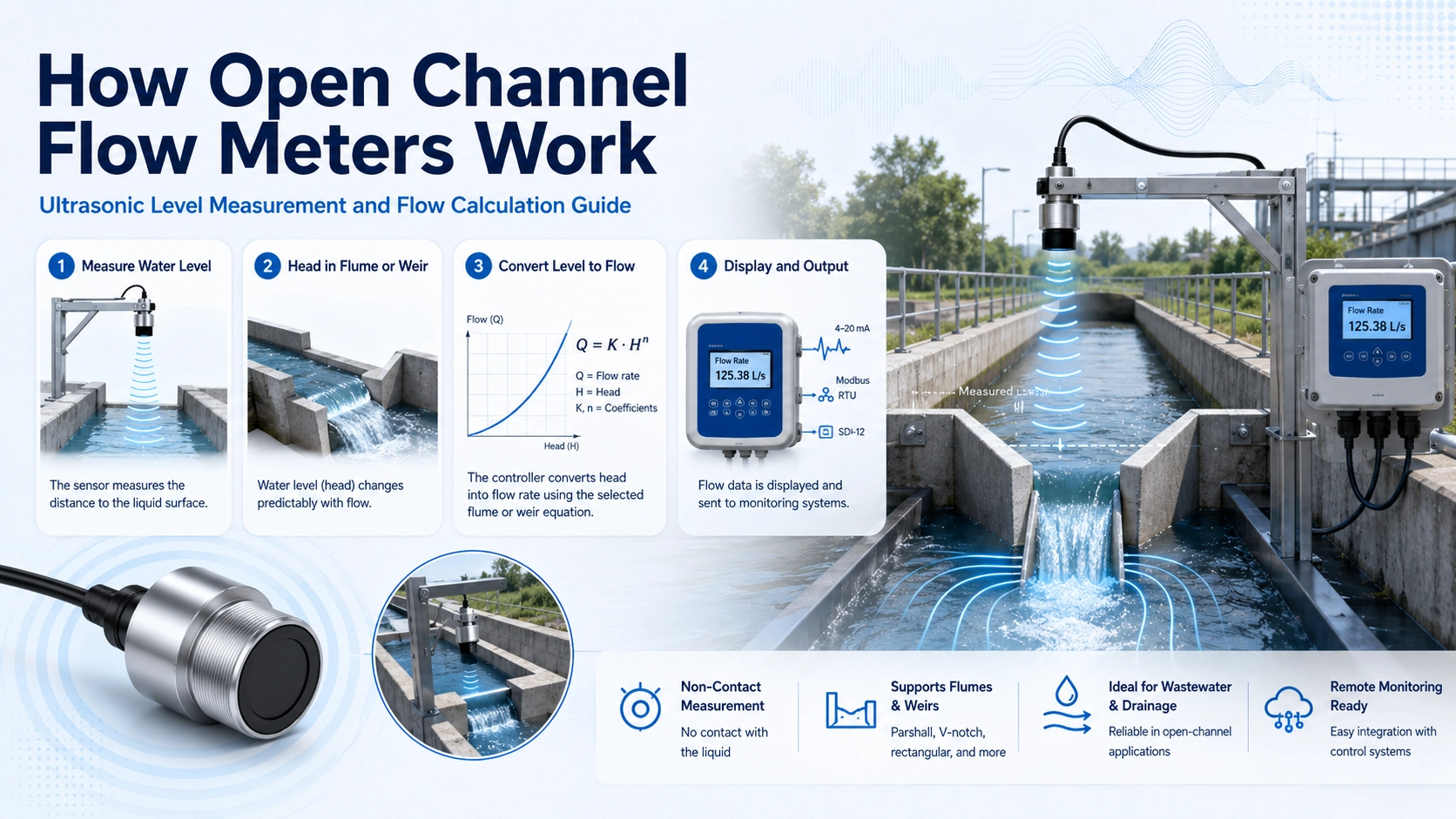
The working principle of an open channel flow meter is based on the relationship between liquid level and flow rate. A flume or weir is installed in the channel to create a predictable hydraulic condition. An ultrasonic sensor is then mounted above the liquid surface to measure the level without contacting the medium.
The ultrasonic sensor emits sound pulses toward the liquid surface and receives the reflected echo. By measuring the travel time of the sound wave, the instrument calculates the distance from the sensor to the liquid surface. From this distance, the system determines the liquid level, also called the head.
The controller then applies the corresponding flow equation for the selected flume or weir and automatically converts the measured level into flow rate. Because the measurement is non-contact, the system is suitable for dirty water, corrosive liquids, wastewater, and other applications where direct-contact instruments may require frequent maintenance.
Main Components of an Open Channel Flow Meter System
A typical open channel flow meter system includes several key components. Each part affects the final measurement result, so the complete system should be selected and installed according to the site conditions.
- Ultrasonic level sensor: measures the liquid level from above the channel without contacting the medium.
- Controller or transmitter: processes the level signal and converts it into flow rate.
- Flume or weir: creates the hydraulic condition required for level-to-flow conversion.
- Output interface: provides local display, analog output, pulse output, relay output, or communication for system integration.
The overall accuracy of the system depends not only on the ultrasonic sensor, but also on correct installation, proper flume or weir sizing, stable upstream flow conditions, and suitable site construction.
Common Types of Weirs and Flumes
Different applications require different hydraulic structures. Common weir types include V-notch weirs, rectangular weirs, and trapezoidal weirs. Common flume types include Parshall flumes, Palmer-Bowlus flumes, and Venturi flumes.
Each structure has its own flow equation, installation requirements, and suitable flow range. In general, weirs are often used for relatively clean water and lower flow ranges, while flumes are often preferred for wastewater and liquids containing suspended solids because they are less likely to clog.
For project selection, the hydraulic structure should be chosen according to the channel size, expected flow range, liquid condition, available installation space, and maintenance requirements.
Where Are Open Channel Flow Meters Used?
Open channel flow meters are widely used in water treatment, environmental monitoring, agriculture, municipal infrastructure, and industrial discharge applications.
- Municipal wastewater treatment plants
- Industrial effluent monitoring
- Drainage and stormwater systems
- Irrigation channels and agricultural water management
- Partially filled sewer lines
- Environmental monitoring projects
- Factory discharge and process water monitoring
In these environments, non-contact ultrasonic measurement provides a practical solution with low maintenance requirements and stable long-term operation.
Advantages of Ultrasonic Open Channel Flow Measurement
Compared with contact-type instruments, ultrasonic open channel flow meters offer several practical advantages in difficult field conditions.
- Non-contact measurement reduces contamination, corrosion, and mechanical wear.
- Suitable for dirty water, wastewater, and corrosive liquid environments.
- Lower maintenance requirements because the sensor is not immersed in the liquid.
- Continuous monitoring with automatic level-to-flow conversion.
- Compatible with different flumes and weirs.
- Suitable for remote monitoring, data logging, and control systems.
For many users, the main benefit is that the system can provide stable flow data without placing the sensor directly into the liquid. This helps reduce maintenance work in wastewater channels, outdoor drainage systems, and industrial discharge sites.
How to Select the Right Open Channel Flow Meter
Selecting the right open channel flow meter requires more than choosing a sensor range. The complete measurement system should match the hydraulic structure, channel conditions, flow range, and output requirements.
| Selection Factor | What to Check |
|---|---|
| Channel type | Confirm whether the site uses an open channel, partially filled pipe, drainage trench, or irrigation canal. |
| Flow range | Select a suitable flume or weir according to the minimum and maximum expected flow rate. |
| Liquid condition | Consider wastewater, suspended solids, foam, corrosive liquids, or surface turbulence. |
| Installation space | Check the available straight channel length, sensor mounting height, and site construction conditions. |
| Output requirements | Confirm whether the project needs local display, 4–20 mA output, pulse output, relay output, or digital communication. |
| Existing structure | Determine whether an existing flume or weir can be used, or whether a new structure must be installed. |
If your application also involves liquid level monitoring, you may compare open channel flow solutions with our BBULM-T top-mounted ultrasonic level meter. For closed full-pipe systems, other ultrasonic flow measurement solutions may be more suitable.
Conclusion
An open channel flow meter is an effective solution for measuring liquid flow in open channels and partially filled pipes. By combining an ultrasonic level sensor with a properly selected flume or weir, the system converts liquid level into flow rate for accurate and continuous monitoring.
This type of system is widely used in wastewater, drainage, irrigation, environmental monitoring, and industrial discharge applications where non-contact measurement and easy maintenance are important. For reliable long-term performance, the correct sensor, hydraulic structure, installation position, and output configuration should be selected according to the actual site conditions.
If you are evaluating an open channel flow monitoring project, please contact Deep-Minds with your channel size, flow range, liquid condition, and installation requirements. Our team can help review the application and recommend a suitable measurement solution.