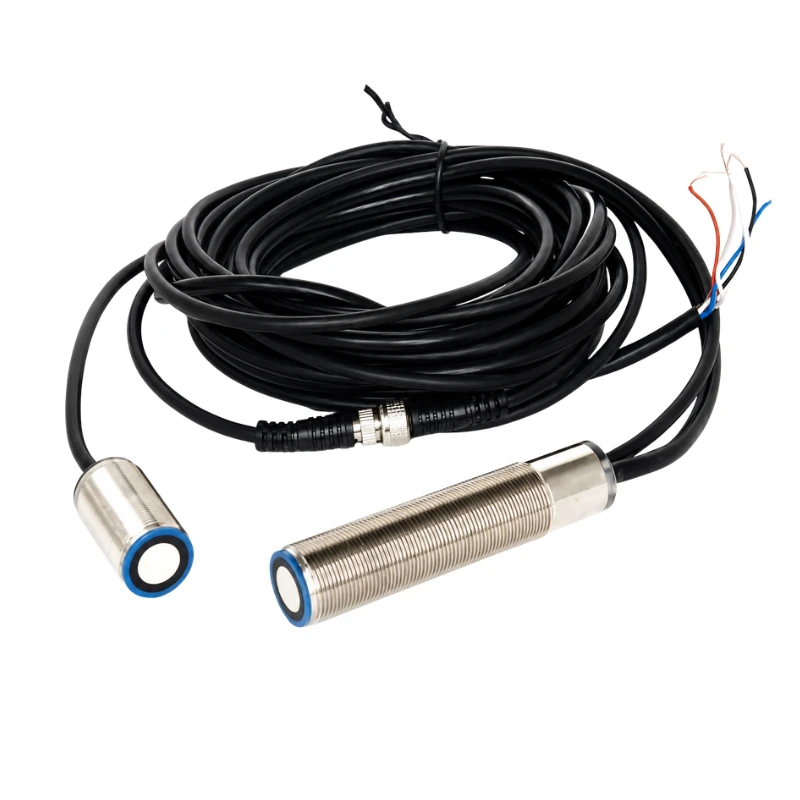
Product Overview
BBID-DSS is a 200 kHz ultrasonic double-sheet detection sensor for identifying no-sheet, single-sheet, and double-sheet conditions in automated feeding processes. The opposed transmitter and receiver provide non-contact detection for feeding, stamping, packaging, printing, binding, and sheet-processing equipment.
Ultrasonic detection is independent of material color and transparency. The sensor can detect double feeds and overlapping sheets made of paper, transparent film, thin metal, solar wafers, printed circuit boards, and coated sheet materials.
Operating Principle
The transmitter continuously sends an ultrasonic signal toward the receiver. As material passes between the two sensor heads, the system evaluates the change in the received signal and provides separate switching outputs for no sheet, one sheet, or two sheets. The three outputs can be connected to a PLC, machine controller, or alarm circuit.
Key Features
- 200 kHz ultrasonic detection
- Non-contact detection of no sheet, single sheet, and double sheet
- Suitable for opaque, transparent, and differently colored sheet materials
- Three NPN normally closed switching outputs
- 100 mA rated operating current per output
- Short-circuit and overload-protected outputs
- Blue, green, and red status indicators
- IP67 protection
- M18 × 1 threaded housing
- 2 m PVC cable
Typical Applications
- Paper feeding and paper-making machinery
- Stamping presses and thin-metal feeding systems
- Food and instant-noodle packaging machinery
- Transparent film and self-adhesive material detection
- Solar wafer production equipment
- PCB and circuit-board feeding systems
- Coating and sheet-processing machinery
- Automatic binding and print-finishing equipment
Detectable Materials
- Paper and cardboard
- Transparent plastic film
- Thin metal sheets
- Solar wafers
- Printed circuit boards
- Coated sheet materials
- Other sheet materials suitable for ultrasonic transmission
Technical Specifications
| Parameter | Specification |
|---|---|
| Detection method | Opposed ultrasonic transmission |
| Ultrasonic frequency | 200 kHz |
| Sensing range | 20–60 mm |
| Optimum installation distance | 45 mm |
| Supply voltage | 18–30 V DC |
| Supply ripple | 10% p-p |
| No-load supply current | < 80 mA |
| Number of outputs | 3 |
| Output type | NPN, normally closed |
| Output states | No sheet / single sheet / double sheet |
| Rated operating current | 3 × 100 mA |
| Output protection | Short-circuit and overload protection |
| Voltage drop | 2 V |
| Switch-on delay | Approx. 15 ms |
| Switch-off delay | Approx. 15 ms |
| Function-input pulse length | 100 ms |
| Function-input impedance | 4 kΩ |
| Function-input low level | -UB to -UB + 1 V |
| Function-input high level | +UB – 1 V to +UB |
| Degree of protection | IP67 |
| Mounting thread | M18 × 1 |
| Cable | 2 m PVC |
| Conductor cross-section | 0.14 mm² |
| Housing | Nickel-plated brass |
| Plastic components | PBT |
| Transducer face | Stainless steel |
| Weight | Approx. 150 g |
Status Indicators
| LED color | Detection status |
|---|---|
| Blue | No sheet / air |
| Green | Single sheet |
| Red | Double sheet |
Cable Connection
| Connection | Function |
|---|---|
| Red | Supply positive |
| Black | Supply negative |
| White | Double-sheet output |
| Green | Single-sheet output |
| Yellow | No-sheet output |
| Function-input wire | Function input |
Installation Guidelines
- Mount the transmitter and receiver opposite each other on the same axis.
- A transmitter-to-receiver distance of 40–45 mm is recommended; the optimum operating distance is 45 mm.
- Keep the moving sheet approximately 5–15 mm from the sensor face.
- Keep angular misalignment between the transmitter and receiver within ±1°.
- Keep axial offset between the transmitter and receiver within ±1 mm.
- For thicker paper, an installation angle of approximately 35° can improve detection.
- After installation, verify all three output states using no sheet, one sheet, and two sheets.
Customization Options
- Response time
- Cable length
- Electrical connection
- Mounting bracket
- Adaptation to the target material and feeding mechanism