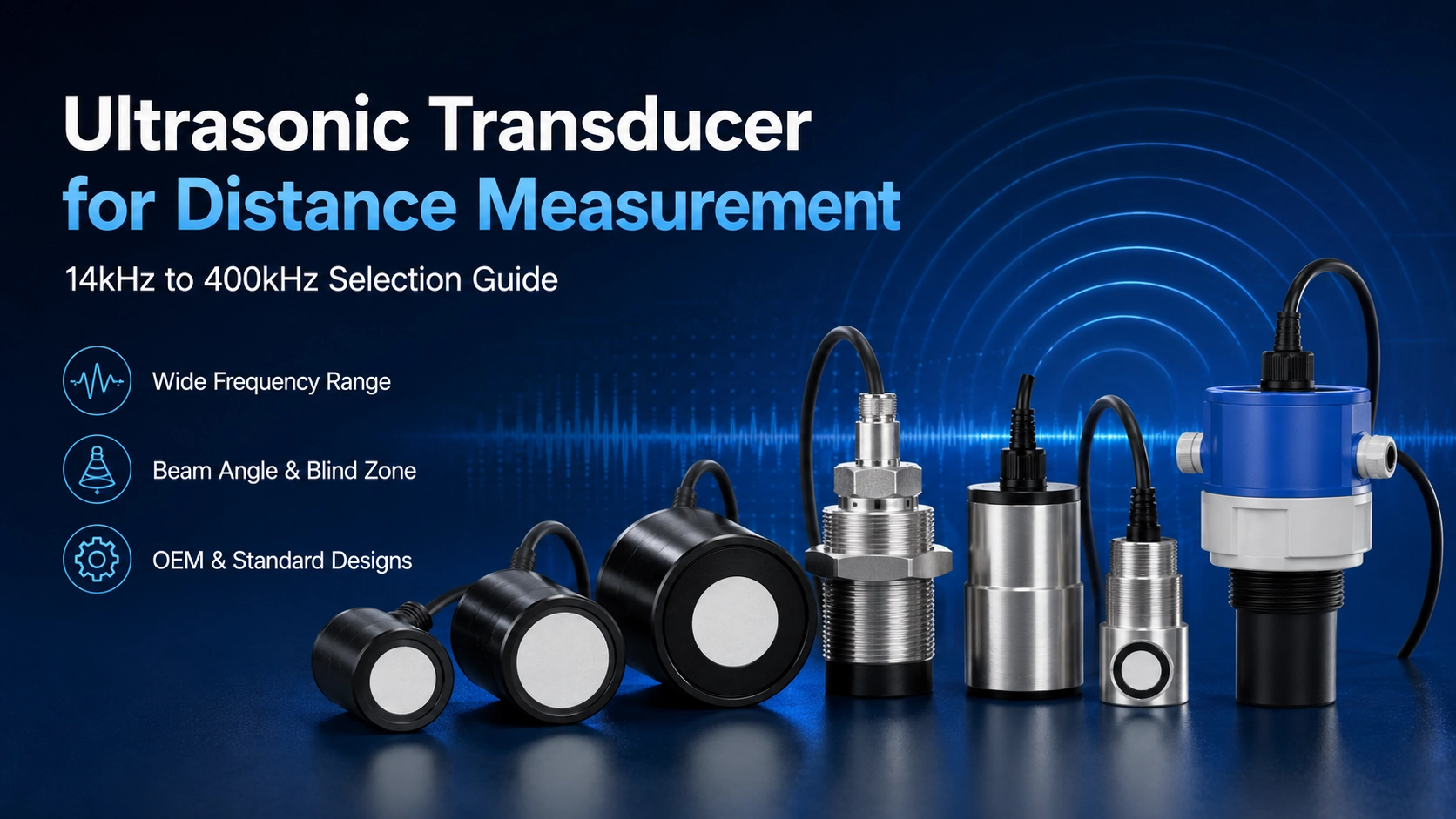
What Is an Ultrasonic Transducer for Distance Measurement?
An ultrasonic transducer for distance measurement is the acoustic component that converts electrical energy into ultrasonic sound waves and converts returning echoes back into electrical signals. In a distance sensing system, the transducer transmits sound into the air, receives the reflected echo from a target, and affects whether the final signal is strong and stable enough for measurement.
A transducer is not the same as a complete ultrasonic sensor. The transducer is the acoustic element, while a sensor or module normally includes the driving circuit, receiving circuit, signal processing, housing, output interface and calibration. For OEM projects, the transducer is often selected first, then matched with the final electronics and mechanical structure.
How Ultrasonic Distance Measurement Works
Most systems use the time-of-flight principle. The circuit excites the transducer at or near its resonant frequency, the sound wave travels through air and reflects from the target, and the receiver detects the echo. The processor then calculates distance from the delay between transmission and reception.
In practice, range depends on more than the formula. Target size, target surface, installation angle, temperature, humidity, airflow, acoustic noise, housing design and transducer behavior all affect echo quality.
Frequency Selection: 14kHz to 400kHz
| Frequency | Typical Direction | Typical Applications |
|---|---|---|
| 14kHz | Longer range | Long-distance detection, large target measurement, industrial sensing |
| 22kHz / 30kHz | Long to medium range | Outdoor detection, large object detection, industrial distance sensing |
| 40kHz | General-purpose range | Parking sensors, object detection, level and distance systems |
| 50kHz / 75kHz | Medium range | Industrial sensing, controlled detection, OEM modules |
| 112kHz / 125kHz | Medium to shorter range | Compact distance sensing, level detection, more directional systems |
| 200kHz | Shorter range / higher resolution | Compact devices and controlled measurement systems |
| 300kHz / 400kHz | Short range / specialized use | High-resolution short-range sensing and compact OEM designs |
There is no universal best frequency. Lower frequencies usually propagate farther in air, while higher frequencies can support better resolution and more compact acoustic designs but attenuate faster.
Range, Beam Angle and Blind Zone
The working range should be evaluated with target condition and installation environment, not as a single catalog number. Hard, flat and perpendicular targets usually return stronger echoes than soft, angled, curved or irregular targets.
Beam angle defines the effective detection area. A wider beam can cover more area but may detect side objects. A narrower beam improves directionality but requires better alignment. The blind zone is the minimum distance near the transducer where stable measurement is difficult because the element is still ringing after transmission.
Housing and Electrical Parameters
Housing design affects acoustic output, beam pattern, waterproofing, mounting stability and long-term reliability. Common options include open type, closed type, waterproof structure, threaded housing, metal housing, plastic housing, custom cable and custom connector.
Before selection, confirm resonant frequency, sound pressure level, receiving sensitivity, capacitance or impedance, drive voltage, beam angle, operating temperature, housing and sealing. Testing the transducer with the final circuit and installation position is strongly recommended.
Applications and Custom Design
Distance measurement transducers are used in industrial object detection, parking assistance, robot and AGV obstacle avoidance, level and distance measurement, smart bins and container monitoring. Standard models are suitable when frequency, range, beam angle and housing already match the application. Custom design may be needed for special frequency, waterproof structure, limited installation space, cable, connector, mounting or batch production requirements.
Quotation Information to Prepare
- Application and measurement range
- Target size, material, surface shape and movement
- Preferred frequency such as 14kHz, 22kHz, 30kHz, 40kHz, 75kHz, 125kHz, 200kHz or 400kHz
- Blind zone and beam angle requirements
- Indoor, outdoor, humid, dusty, windy, high-temperature, low-temperature or noisy environment
- Housing, waterproofing, cable, connector and electrical requirements
- Prototype, sample evaluation, pilot run or mass production stage
Deep Minds provides standard and custom ultrasonic transducers from 14kHz to 400kHz for distance measurement, level sensing, object detection, parking assistance, robot obstacle avoidance and OEM sensing systems.