Introduction
Smart water metering is becoming an important part of modern water management. Compared with manual meter reading, a LoRaWAN-based system can improve data collection efficiency, reduce labor workload, and support more accurate usage monitoring across residential, commercial, municipal, and industrial projects.
Water metering usually involves small data packets, long communication distances, and battery-powered field devices. For this type of deployment, LoRaWAN is a practical communication technology because it combines low power consumption, wide-area coverage, and good network scalability. These characteristics make it suitable for remote meter reading and digital utility management.
What Is LoRaWAN in Smart Water Metering?
LoRa is the wireless transmission technology, while LoRaWAN is the network protocol built on top of it. In simple terms, LoRa handles the radio communication, and LoRaWAN defines how devices connect to the network, send data, interact with gateways, and communicate with management platforms.
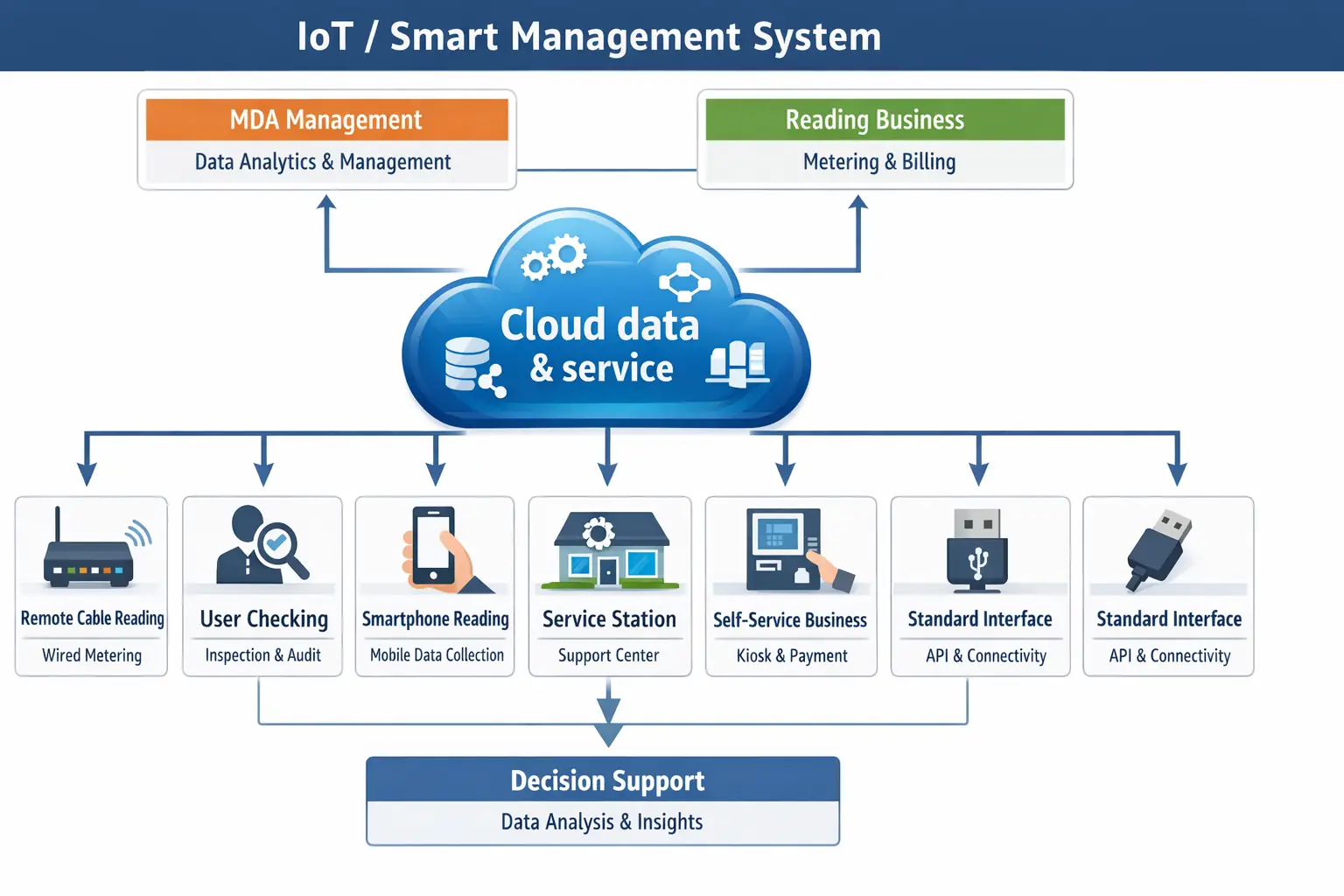
In smart water metering, a typical LoRaWAN system includes water meters, communication modules, gateways, and a cloud-based management platform. This structure allows utilities and operators to collect readings remotely, monitor device status, and manage a large number of endpoints more efficiently.
For readers who need a technical overview of the protocol, the LoRa Alliance introduction to LoRaWAN is a useful reference.
Why LoRaWAN Is Suitable for Smart Water Metering
Water meters do not require high-bandwidth communication. In most applications, the transmitted data is relatively small, such as meter readings, device status, battery information, alarms, or valve status. What matters more is stable long-distance transmission, low power consumption, and reliable operation over long service cycles.
LoRaWAN is well suited to these requirements because it offers several practical advantages:
- Long-range wireless coverage for distributed meter installations
- Low power consumption for battery-powered devices
- Good scalability for multi-node and large-area deployments
- Support for remote data collection and centralized management
- Suitable architecture for smart city and utility infrastructure projects
These advantages make LoRaWAN useful in residential communities, apartment buildings, commercial facilities, industrial parks, municipal water networks, and other distributed metering scenarios.
Key Applications of LoRaWAN in Water Management
Remote Meter Reading
Remote meter reading is one of the most common applications of LoRaWAN smart water metering. Instead of sending staff to collect readings on site, utilities can retrieve water consumption data through the network. This improves operational efficiency and enables more frequent data collection.
Battery Status Monitoring
Battery life is a major consideration in smart metering projects. Many water meters are installed in meter wells, basements, outdoor boxes, or other locations that are not convenient for frequent maintenance. Low-power communication helps extend operating life and reduce maintenance frequency.
Valve Control and Device Management
In some projects, smart water meters are used not only for data reading but also for remote control functions, such as valve management. This allows operators to improve service response, manage abnormal usage conditions, and strengthen field operation control.
Smart Utility and City-Scale Deployment
LoRaWAN is also suitable for projects that need to scale from a limited pilot installation to a larger deployment. For utilities planning long-term digital infrastructure, networked meter management is often more practical than isolated point-to-point communication.
LoRa vs. LoRaWAN: Which One Should You Choose?
For smaller and simpler projects, LoRa point-to-point communication may be sufficient. It can reduce system complexity and hardware cost when the number of endpoints is limited and centralized platform management is not required.
For larger projects, LoRaWAN is usually the better choice. It is more suitable when the system requires stronger security, better interoperability, gateway-based network access, and centralized management through a platform. This is especially important for utility-scale remote metering systems where the number of devices may grow over time.
Benefits of LoRaWAN Smart Water Metering
LoRaWAN smart water metering can help utilities, property operators, and project integrators achieve several practical benefits:
- Reduced manual meter reading workload
- Improved billing accuracy through digital data collection
- Lower maintenance frequency with low-power field devices
- Better visibility into device status and field operation conditions
- Improved support for remote monitoring and data management
- Stronger scalability for future network expansion
For buyers evaluating deployed hardware, you can review our LoRaWAN remote water meter for product details and application fit.
Conclusion
LoRaWAN provides an efficient approach to remote water meter reading and smart utility management. With long-range communication capability, low power consumption, and support for distributed deployments, it is a strong option for modern water metering systems.
For utility projects, commercial installations, industrial parks, and smart city applications, the key value of LoRaWAN lies in improving operational efficiency while enabling more intelligent and scalable infrastructure.
To explore the metering hardware, review our BBUWM-S smart ultrasonic water meter or contact our team for technical support and project evaluation.