Selection

Showing 1-3 of 3 articles

Category: Selection Clear filters
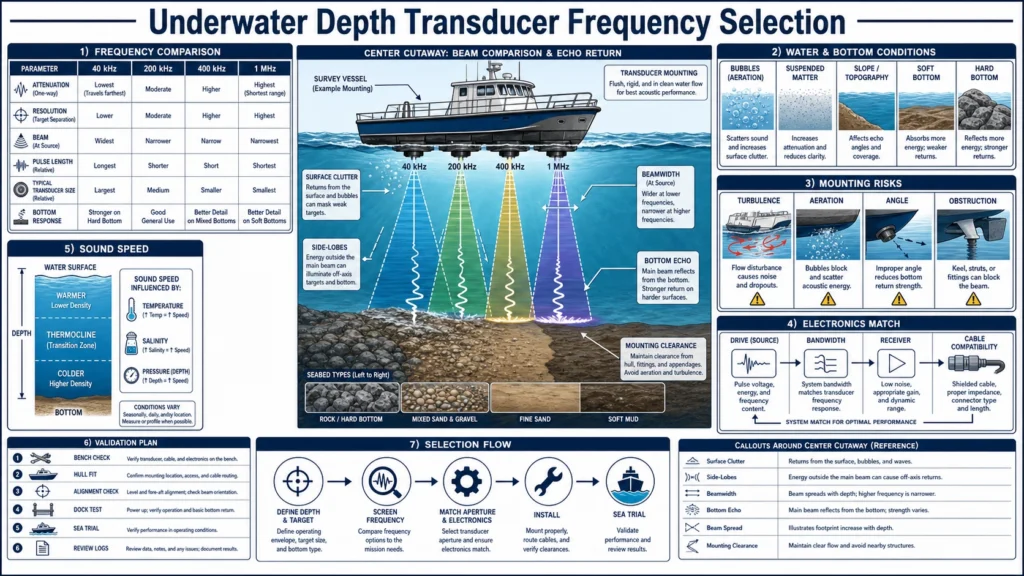
Underwater depth transducers emitting low- and high-frequency sonar beams toward different bottom layers

Published 2026-08-24

Underwater Depth Transducer Selection: 40 kHz vs 200 kHz vs 400 kHz vs 1 MHz

An underwater depth transducer sends acoustic energy toward the bottom and receives returned echoes. Frequency affects wavelength, attenuation, beam pattern, transducer size, pulse design, and the way different bottom materials appear, but it does not assign a guaranteed maximum depth by itself. The result also depends on transmit energy, pulse length, receiver noise, bandwidth, aperture, installation, vessel motion, water properties, bottom slope and reflectivity, bubbles,…
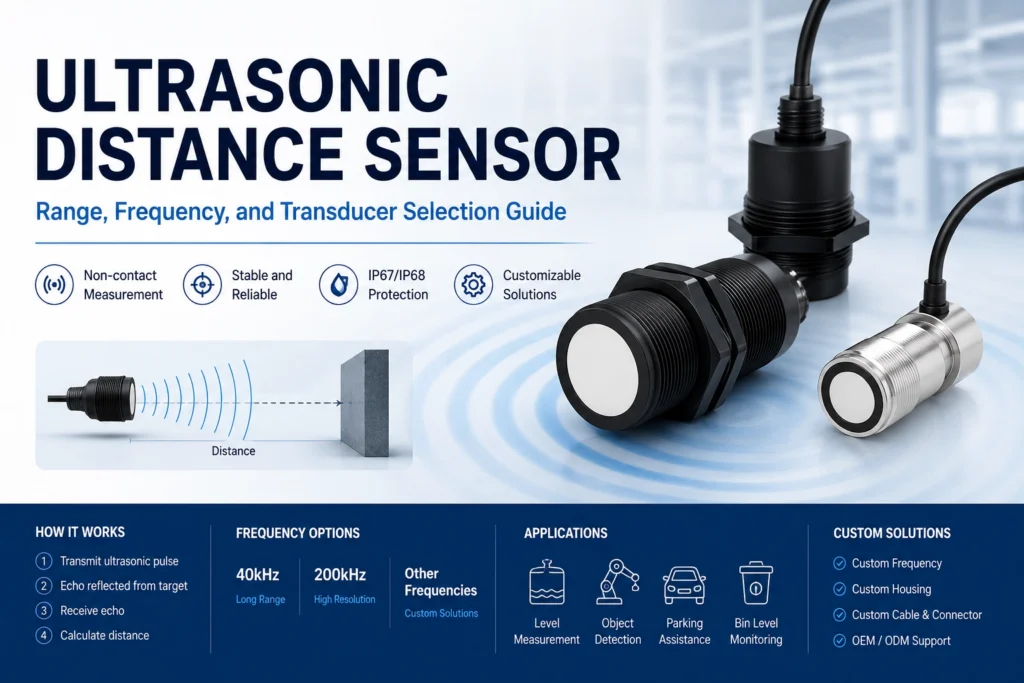
Ultrasonic distance sensor for industrial non-contact distance measurement.

Published 2026-05-07 Updated 2026-08-21

Ultrasonic Distance Sensor: Range, Frequency, and Transducer Selection Guide

An ultrasonic distance sensor is a non-contact measuring device used to detect the distance between the sensor and a target object. It works by sending ultrasonic sound waves toward the target and receiving the reflected echo. Because it does not require physical contact, this type of sensor is widely used in industrial automation, level monitoring, object detection, parking assistance, robotics, and other measurement systems.

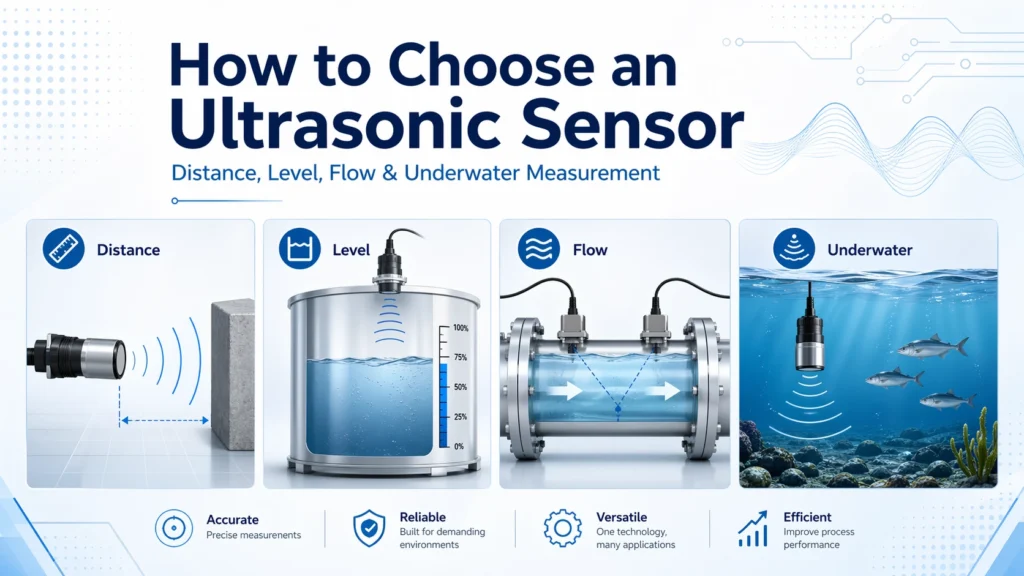
How to choose an ultrasonic sensor for distance, level, flow, and underwater measurement applications

Published 2026-04-24 Updated 2026-08-21

How to Choose an Ultrasonic Sensor for Distance, Level, Flow, and Underwater Measurement

Ultrasonic sensors are widely used in distance measurement, liquid level detection, flow metering, underwater acoustic sensing, object detection, and industrial automation. Although these applications all use ultrasonic waves, the required sensor structure, operating frequency, beam angle, housing material, output signal, and environmental protection level can be very different.