What Is an Ultrasonic Level Meter?
An ultrasonic level meter is a level measurement device that uses ultrasonic sound waves to measure the distance between the sensor and the surface of a liquid or solid material. In many tank and process applications, this distance is then converted into a level value based on the tank height or installation position.
Unlike mechanical float switches or contact-type level sensors, an ultrasonic level meter can measure without direct contact with the measured medium. This makes it suitable for water tanks, sewage tanks, diesel tanks, storage vessels, open channels, and some solid material containers where contamination, corrosion, or mechanical wear should be reduced.
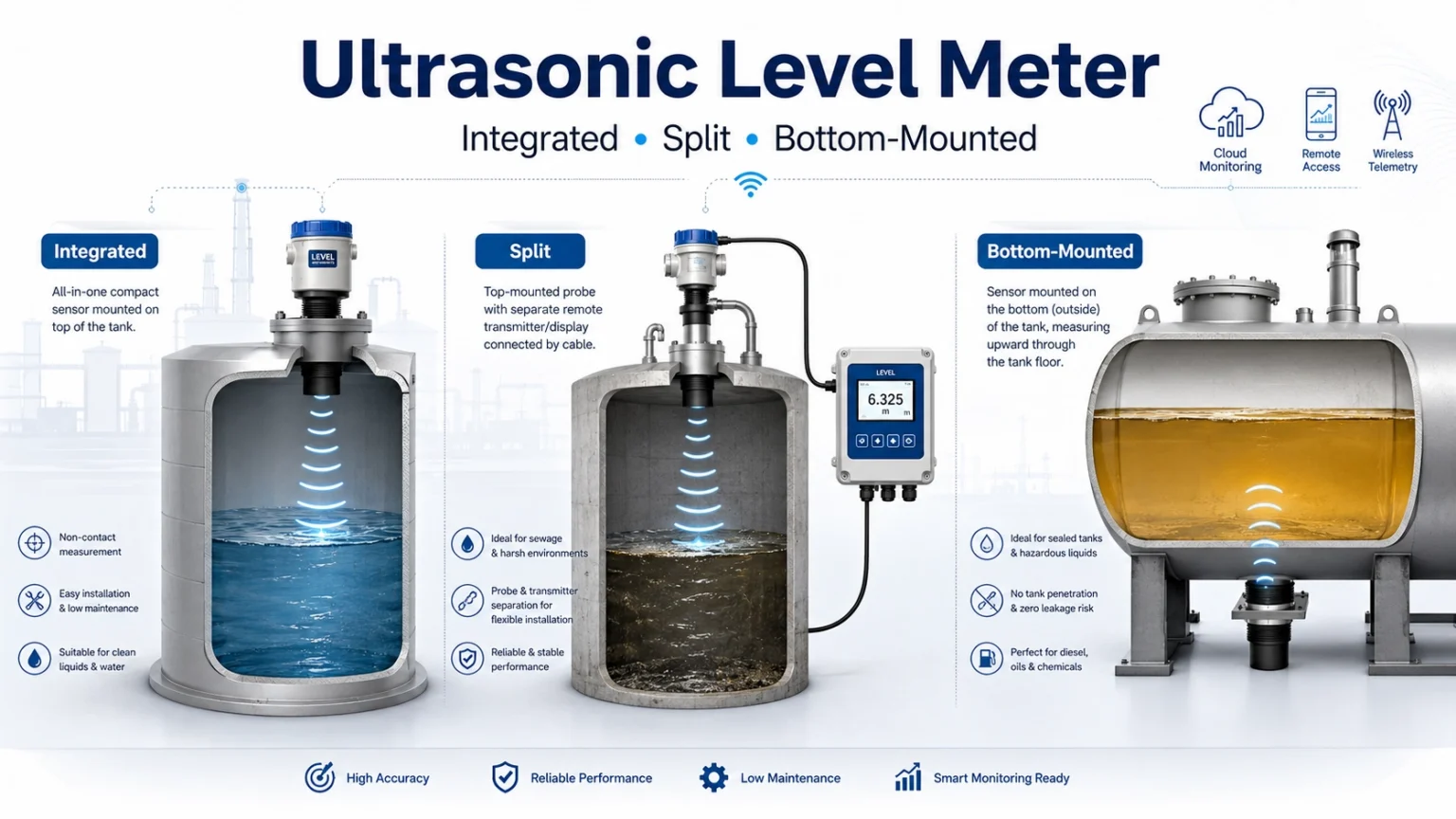
In a complete level measurement system, the instrument may include an ultrasonic probe, signal processing electronics, display, output interface, housing, cable, and mounting accessories. Depending on the installation condition, it can be designed as an integrated type, a split type, or a bottom-mounted type.
Deep Minds provides the BBULM-T top-mounted ultrasonic level meter for non-contact level measurement, external bottom-mounted tank monitoring, high and low level alarms, telemetry input, and remote monitoring applications.
How Ultrasonic Level Measurement Works
Most ultrasonic level meters use the time-of-flight principle. The ultrasonic probe emits a sound pulse toward the liquid or material surface. When the sound wave reaches the surface, part of the energy is reflected back to the probe. The meter calculates the distance by measuring the time between transmission and echo reception.
For top-mounted level measurement, the instrument is usually installed above the liquid or solid surface. The meter measures the empty space between the probe and the surface, then calculates the level according to the tank height.
For bottom-mounted level measurement, the sensor is installed externally at the bottom of the container. This structure is used when the tank should not be drilled or opened, or when external installation is preferred for safety, maintenance, or retrofit reasons.
Ultrasonic technology is based on sound waves above the upper limit of human hearing. For a general technical definition, see this reference on ultrasonics.
Top-Mounted Measurement
Top-mounted ultrasonic level meters are installed above the measured surface. The ultrasonic wave travels downward, reflects from the liquid or material surface, and returns to the probe. This method is commonly used for water tanks, sewage tanks, storage tanks, open vessels, and solid distance measurement.
Integrated and split ultrasonic level meters usually use this measurement structure. The key requirements are a clear acoustic path, suitable measuring range, proper mounting angle, and enough distance to avoid the blind zone near the probe.
Bottom-Mounted Measurement
A bottom-mounted ultrasonic level meter is installed outside the bottom of the tank or container. It measures the liquid level without opening the tank wall or inserting a probe into the medium. This design can be useful for sealed tanks, diesel fuel monitoring, liquid asset inventory, and retrofit projects where drilling is not preferred.
Bottom-mounted measurement requires a compatible tank bottom, suitable liquid medium, stable installation surface, and good acoustic coupling between the sensor and the container.
Main Types of Ultrasonic Level Meters
Ultrasonic level meters are not all installed in the same way. The best design depends on tank structure, medium type, installation space, output requirement, and maintenance conditions. The three most common types are integrated, split, and bottom-mounted ultrasonic level meters.
Integrated Ultrasonic Level Meter
An integrated ultrasonic level meter combines the ultrasonic probe, electronics, housing, and output interface in one compact device. It is usually installed at the top of the tank or vessel and measures downward toward the liquid or material surface.
This type is suitable for standard tank installations where the instrument can be mounted directly above the measured surface. It is often selected for water tanks, sewage tanks, storage tanks, open vessels, and outdoor level monitoring systems.
The AI-ULM integrated ultrasonic level meter is designed for non-contact level measurement of liquids and distance measurement of solids. It supports a measuring range from 30 mm to 60,000 mm, RS485 default output, and industrial level monitoring applications.
Integrated design is usually preferred when installation is straightforward, local device mounting is convenient, and the site does not require the display or transmitter to be separated from the probe.
Split Ultrasonic Level Meter
A split ultrasonic level meter separates the ultrasonic probe from the transmitter, display, or control unit. The probe is installed at the measuring point, while the electronics can be mounted in a more convenient or safer location.
This design is useful when the tank top is difficult to access, the measuring point is humid or exposed, the display needs to be installed at eye level, or the electronics should be kept away from vibration, heat, or harsh process conditions.
The AS-ULM split ultrasonic level meter is suitable for non-contact level measurement of liquids and distance measurement of solids. It supports a measuring range from 30 mm to 60,000 mm, RS485 default output, and separated installation between probe and transmitter.
Split design is often used in large tanks, water and sewage monitoring, industrial process vessels, solid material tanks, telemetry systems, and sites where remote display or easier maintenance is required.
Bottom-Mounted Ultrasonic Level Meter
A bottom-mounted ultrasonic level meter measures liquid level from outside the bottom of the container. Unlike top-mounted models, it does not require a probe to be installed above the liquid surface. It also does not require the container to be opened from the top.
The B-ULM bottom mounted ultrasonic level meter is designed to measure liquid level from the outside bottom of a container. It can be used for water, diesel, gas, LPG, and other liquid monitoring applications.
The B2-ULS and B5-ULS bottom-mounted ultrasonic level meters are also designed for external bottom installation. They are suitable for applications such as diesel fuel gauging, liquid asset inventory, high and low level alarms, and irrigation control.
Bottom-mounted design is preferred when the tank should not be drilled, when the liquid should not contact the sensor, or when external installation is safer and easier for maintenance. It is especially useful for sealed tanks, retrofit monitoring, and fuel or liquid inventory systems.
Integrated vs Split vs Bottom-Mounted: Comparison Table
| Type | Installation Method | Best For | Main Advantages | Selection Notes |
|---|---|---|---|---|
| Integrated ultrasonic level meter | Probe and electronics in one unit, usually top-mounted | Standard tanks, water tanks, sewage tanks, simple outdoor monitoring | Compact structure, easier installation, fewer separate components | Requires suitable top mounting space and a clear acoustic path |
| Split ultrasonic level meter | Probe and transmitter/display installed separately | Large tanks, difficult access points, harsh sites, remote display applications | Flexible installation, easier display access, electronics can be mounted away from harsh areas | Cable routing and transmitter location should be planned before installation |
| Bottom-mounted ultrasonic level meter | Externally installed at the tank bottom | Diesel tanks, sealed containers, liquid inventory, no-drilling installations | No tank opening required, external installation, suitable for retrofit projects | Requires compatible tank material, tank bottom structure, and liquid medium |
Key Factors When Choosing an Ultrasonic Level Meter
Choosing an ultrasonic level meter should not be based only on measuring range or price. The installation type, measured medium, tank structure, surface condition, output signal, and environment all affect measurement stability and long-term reliability.
Measuring Medium: Liquids, Solids, Water, Sewage, and Diesel
Different media reflect ultrasonic waves differently. Clean water and many stable liquids are relatively easy to measure. Sewage, wastewater, foaming liquids, vapor, turbulent surfaces, and corrosive environments require more careful evaluation.
Solid level or solid distance measurement can also be possible, but the material surface may be sloped, dusty, uneven, or absorbent. These conditions can weaken the reflected echo and reduce measurement stability.
For diesel tanks and liquid inventory applications, bottom-mounted models may be suitable when external installation and no-drilling measurement are required.
Measurement Range and Blind Zone
The required measuring range should include both the maximum tank height and the minimum measurable distance near the sensor. Ultrasonic level meters have a blind zone near the probe where measurement may not be reliable because the transducer is still settling after transmitting the pulse.
For top-mounted models, the probe should be installed with enough clearance above the highest expected level. For bottom-mounted models, the tank structure, liquid depth, and acoustic coupling condition should be checked before selection.
Tank Geometry and Mounting Position
Tank shape has a direct effect on ultrasonic level measurement. Tall narrow tanks, tanks with internal pipes, agitators, ladders, brackets, inlet streams, or uneven bottoms may create false echoes or unstable readings.
For top-mounted measurement, the probe should be installed where the ultrasonic beam can reach the liquid or material surface without hitting internal obstacles. For split models, the probe position and transmitter location should both be considered during installation planning.
Foam, Vapor, Turbulence, and Dust
Foam can absorb or scatter ultrasonic energy, reducing the strength of the return echo. Vapor and condensation may affect sound propagation and sensor reliability. Turbulent liquid surfaces can cause unstable reflections. Dust in solid material tanks can also weaken the echo signal.
In these conditions, the selection should consider measuring range margin, installation position, signal processing, environmental protection, and whether an alternative measurement method may be needed for severe process conditions.
Output Signal and System Integration
Output signal is important when the level meter needs to connect with a PLC, telemetry system, alarm device, data logger, or remote monitoring platform. Common output requirements may include RS485, Modbus, 4–20mA, relay output, or customized communication interfaces.
For smart monitoring and industrial integration, confirm the output type, power supply, communication protocol, cable length, and data collection requirements before selecting the model.
Environmental Protection and Reliability
Outdoor, humid, corrosive, dusty, or high-condensation environments require suitable housing and protection. The probe, transmitter, cable entry, connector, and mounting accessories should be selected according to the site conditions.
For long-term operation, also consider temperature range, vibration, UV exposure, rain, splashing water, chemical vapor, and maintenance access. A level meter that works in a clean test environment may need additional protection in an industrial or outdoor installation.
Typical Applications
Water Tank Level Measurement
Ultrasonic level meters are commonly used for water tank level monitoring in buildings, water supply systems, irrigation systems, and industrial storage tanks. Integrated models are suitable for simple top-mounted installations, while split models are useful when the display or transmitter needs to be installed separately.
Sewage and Wastewater Monitoring
Sewage tanks, wastewater pits, pump stations, and treatment systems often require non-contact level measurement because the medium may be dirty, corrosive, or difficult to access. A properly installed ultrasonic level meter can reduce mechanical contact with the medium and simplify maintenance.
Diesel Fuel Gauging
Diesel tank monitoring often requires safe, stable, and non-invasive level measurement. Bottom-mounted ultrasonic level meters can be suitable when the tank should not be drilled or when external installation is preferred for retrofit monitoring and liquid inventory management.
Solid Distance Measurement
Some ultrasonic level meters can measure the distance to solid materials inside bins, silos, or containers. In these applications, material angle, dust, particle size, filling pattern, and surface stability should be evaluated carefully.
High and Low Level Alarms
Ultrasonic level meters can be used to trigger high or low level alarms for tanks, containers, fuel systems, water systems, and industrial storage applications. Alarm requirements should be confirmed together with output signal, relay function, response time, and control system compatibility.
Remote Monitoring and Telemetry
In remote water, sewage, irrigation, or tank inventory applications, the level meter may need to connect with telemetry equipment, data loggers, or cloud platforms. In these cases, communication output, power consumption, cable distance, and environmental protection are important selection factors.
How to Select the Right Model
The easiest way to choose an ultrasonic level meter is to start with the installation method. After that, confirm the medium, measuring range, output signal, and environmental conditions.
| Requirement | Recommended Type |
|---|---|
| Simple top-mounted tank measurement | Integrated ultrasonic level meter |
| Probe and display need to be installed separately | Split ultrasonic level meter |
| Tank cannot be drilled or opened | Bottom-mounted ultrasonic level meter |
| Outdoor water or sewage monitoring | Integrated or split type, depending on installation conditions |
| Diesel tank or liquid asset inventory | Bottom-mounted type |
| Solid distance measurement in tanks or containers | Integrated or split type |
| Remote monitoring or telemetry input | Model with suitable communication output |
| Harsh or wet measuring point | Confirm IP rating and consider split installation |
If the application is a standard open or closed tank with convenient top access, an integrated ultrasonic level meter is usually the simplest choice. If the site requires separate installation between the probe and display, a split model is more suitable. If the tank should not be opened or drilled, a bottom-mounted model should be evaluated.
Information to Prepare Before Requesting a Quotation
To recommend the right ultrasonic level meter, the supplier needs to understand the application and installation conditions. Before requesting a quotation, prepare the following information where possible.
| Information Needed | Example Details |
|---|---|
| Application | Water tank, sewage tank, diesel tank, storage vessel, solid material bin, alarm system, remote monitoring |
| Measured medium | Water, wastewater, diesel, LPG, chemical liquid, powder, granules, or other material |
| Tank dimensions | Tank height, diameter, shape, wall material, and bottom structure |
| Required measuring range | Minimum and maximum level or distance to be measured |
| Installation method | Integrated top-mounted, split top-mounted, or bottom-mounted external installation |
| Surface condition | Foam, vapor, turbulence, dust, uneven solid surface, or stable liquid surface |
| Environment | Indoor, outdoor, humid, corrosive, dusty, high temperature, low temperature, or vibration conditions |
| Output signal | RS485, Modbus, 4–20mA, relay alarm, telemetry input, or customized output |
| Power supply | Required voltage, battery system, solar system, or control cabinet power |
| Project stage | Sample testing, pilot project, replacement, retrofit, or mass deployment |
For complex applications, photos, installation drawings, tank drawings, or existing device specifications can help speed up model selection and quotation.
FAQ
What is an ultrasonic level meter used for?
An ultrasonic level meter is used to measure liquid level, solid level, or distance to a material surface. Common applications include water tanks, sewage tanks, diesel tanks, storage vessels, solid material containers, high and low level alarms, and remote monitoring systems.
What is the difference between an integrated and split ultrasonic level meter?
An integrated ultrasonic level meter combines the probe and electronics in one device. A split ultrasonic level meter separates the probe from the transmitter or display unit. Integrated models are suitable for simple installations, while split models are better when the display needs to be mounted remotely or the measuring point is difficult to access.
When should I choose a bottom-mounted ultrasonic level meter?
A bottom-mounted ultrasonic level meter should be considered when the tank should not be drilled, opened, or modified. It is also useful for sealed tanks, diesel fuel gauging, liquid asset inventory, high and low level alarms, and retrofit applications where external installation is preferred.
Can ultrasonic level meters measure solids?
Yes, some ultrasonic level meters can measure the distance to solid materials. However, solid material measurement requires careful evaluation because dust, uneven surfaces, sloped material, and weak reflection can affect measurement stability.
What affects ultrasonic level measurement accuracy?
Accuracy can be affected by measuring range, blind zone, tank geometry, mounting position, foam, vapor, turbulence, dust, temperature, echo strength, beam angle, output configuration, and signal processing. Correct installation is as important as selecting the right model.
What information is needed to select an ultrasonic level meter?
Useful information includes the measured medium, tank dimensions, required measuring range, installation method, surface condition, environment, output signal, power supply, alarm requirement, communication requirement, and project stage.
Conclusion
Selecting an ultrasonic level meter starts with choosing the right installation type. An integrated ultrasonic level meter is suitable for standard top-mounted tank measurement. A split ultrasonic level meter is better when the probe and display or transmitter should be installed separately. A bottom-mounted ultrasonic level meter is useful when the tank should not be drilled or opened.
After the installation type is defined, the medium, measuring range, blind zone, tank structure, surface condition, output signal, and environmental protection should be checked carefully. These factors determine whether the level meter can provide stable measurement in the actual application.
Deep Minds provides AI-ULM integrated ultrasonic level meters, AS-ULM split ultrasonic level meters, and B-ULM / B2-ULS / B5-ULS bottom-mounted ultrasonic level meters for water tanks, sewage monitoring, diesel fuel gauging, liquid inventory, solid distance measurement, alarms, and remote monitoring.
Contact Deep Minds to choose the right ultrasonic level meter for your tank, liquid, solid, or remote monitoring application.