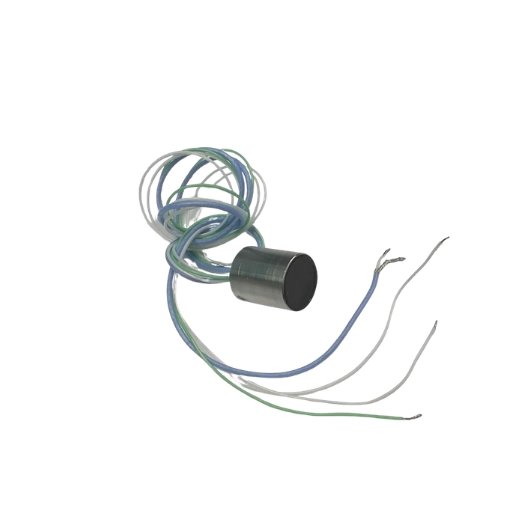
Product Overview
The BB-FS200-1214A is a 200kHz ultrasonic transducer designed for anemometer measurement applications. It features an integrated heater and temperature sensor, a 316 stainless steel housing, and an IP65 protection rating.
This model is designed for stable ultrasonic signal transmission and receiving performance under specified operating conditions. It includes dedicated wire connections for the core transducer, temperature sensor, and heater.
Key Features
- Model: BB-FS200-1214A
- Resonance center frequency: 200kHz ±4%
- Frequency bandwidth: 10kHz
- Comprehensive sending and receiving sensitivity: -80dB min
- Beam angle (-3dB full open angle): 20±2°
- Blind zone: less than 10cm
- IP65 protection rating
- 316 stainless steel housing
- Built-in PTC heat ceramics
- Heating voltage: 12V
- Heating impedance: 20-35Ω
- Working temperature: -40 to 70°C
Wiring Information
- Blue: core wire transducer +
- Shielded wire: common –
- White: connect to temperature sensor
- Green: connect to heater +
Application
The BB-FS200-1214A ultrasonic transducer is suitable for anemometer measurement systems that require ultrasonic signal transmission, receiving performance, and temperature-related functionality.
It is appropriate for applications where stable ultrasonic performance is required under controlled operating conditions.
Specifications Summary
- Model: BB-FS200-1214A
- Frequency: 200kHz ±4%
- Bandwidth: 10kHz
- Electrostatic capacity: 400PF ±20%
- Minimum impedance in parallel: 600Ω ±30%
- Maximum working voltage: less than 500V, duty cycle 2%
- Cable type: Two-core poly tetra fluoroethylene shielding cable
- Cable length: 350mm
- Heating temperature: 50-70°C
Notes
The listed performance data is measured under a 25°C environment. Actual performance may vary depending on installation conditions, driving circuit, and system configuration.