What Is an Ultrasonic Water Meter?
An ultrasonic water meter is a flow measurement device that uses ultrasonic signals to measure water flow without mechanical moving parts in the measuring channel. Instead of relying on an impeller, piston, or turbine, it measures the time difference between ultrasonic signals traveling with and against the water flow.
This measurement method is commonly known as the transit-time principle. When water flows through the pipe, the ultrasonic signal traveling downstream moves slightly faster than the signal traveling upstream. The meter calculates the flow rate based on this time difference and then accumulates the total water volume.
Because there are no mechanical moving parts in the flow channel, ultrasonic water meters are suitable for smart metering, remote reading, low-flow monitoring, leakage detection, and long-term water consumption management. For a technology comparison, you can also read our guide on ultrasonic water meter vs mechanical water meter.
Deep Minds provides the BBUWM-S smart ultrasonic water meter as a reference solution for residential, commercial, municipal, and industrial smart water metering projects.
Why Ultrasonic Water Meters Are Used in Smart Metering
Smart metering projects require more than basic water volume measurement. Utilities, property managers, industrial users, and smart city operators often need remote reading, event alarms, low-flow detection, communication interfaces, and platform integration. Ultrasonic water meters are well suited for these requirements because they combine electronic measurement with digital communication.
Typical smart metering functions may include:
- Remote meter reading without manual site visits
- Automatic data reporting to utility or property management platforms
- Low-flow measurement for small consumption or leakage monitoring
- Reverse flow detection and abnormal water usage alarms
- Pipe leakage, pipe burst, scaling, or battery abnormality detection
- Valve control for prepaid water management or remote shutoff
- Wireless or wired communication through NB-IoT, CAT.1, RS485, M-BUS, GPRS, pulse, or 4–20mA output
- IP68 protection for humid, underground, or outdoor environments
For residential and commercial users, smart metering helps reduce manual reading costs and improve billing accuracy. For municipal and industrial projects, it supports pipe network monitoring, district metering areas, water loss management, and long-term consumption analysis.
DN15 to DN500 Product Selection Overview
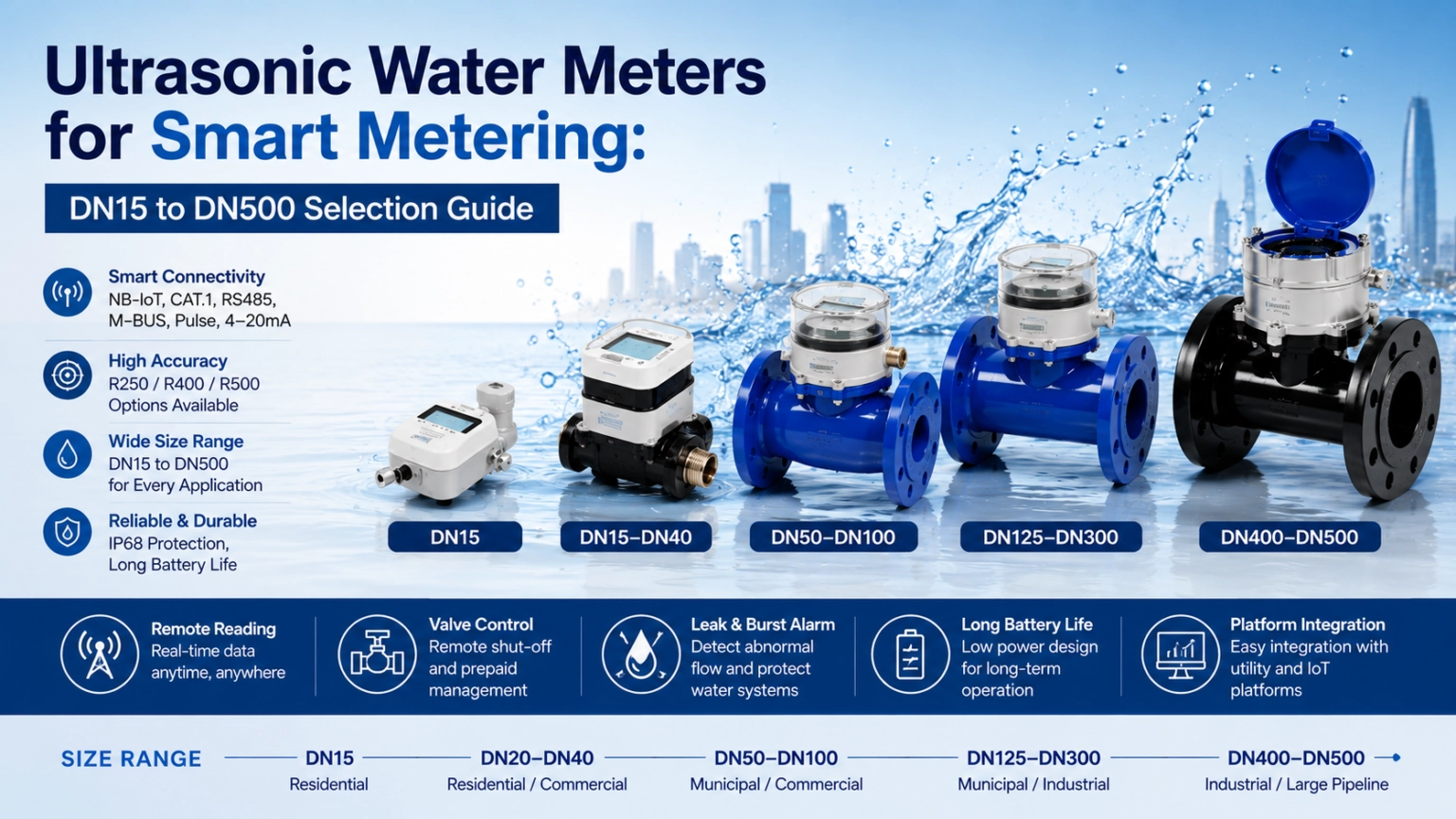
Ultrasonic water meter selection should start with the pipe diameter and project type. DN15 meters are commonly used for residential or drinking water metering, while DN50 to DN500 meters are used for municipal pipelines, industrial water systems, and large-diameter flow measurement. Communication method, accuracy requirement, valve control, battery life, and installation environment should also be confirmed.
| Meter Type | Nominal Diameter | Best For | Communication | Key Selection Notes |
|---|---|---|---|---|
| Drinking water ultrasonic meter | DN15 | Direct drinking water, residential drinking water, compact metering | NB-IoT / CAT.1 | Suitable for small-diameter drinking water metering and remote reading |
| Remote reading smart water meter | DN15, DN20, DN25, DN32, DN40 | Residential, apartment, commercial, and municipal remote reading | NB-IoT, CAT.1, RS485, M-BUS | Suitable for large-scale smart metering deployment |
| Valve-controlled smart water meter | DN15, DN20, DN25 | Prepaid water management, remote shutoff, leakage control | NB-IoT, CAT.1, RS485, M-BUS | Built-in valve supports remote opening and closing |
| S-UWM ultrasonic water meter | DN15, DN20, DN25 | Low-start-flow residential metering and long battery life projects | Remote reading options | Suitable for fine consumption measurement and long-term deployment |
| V-UWM ultrasonic water meter | Depends on model | Prepaid management, remote control, leakage and burst alarm | Remote reading and control options | Built-in valve design for smart water control applications |
| Large-diameter ultrasonic water meter | DN50 to DN500 | Municipal water supply, industrial water metering, pipe network monitoring | RS485, M-BUS, NB-IoT, CAT.1, pulse, 4–20mA, GPRS | Flanged connection for large pipeline and district metering applications |
DN15 Ultrasonic Water Meter for Drinking Water
A DN15 ultrasonic water meter is commonly selected for small-diameter drinking water and residential water metering. It is suitable for applications where compact installation, stable low-flow measurement, and remote reading are required.
The DN15 ultrasonic water meter for drinking water metering is designed for drinking water and direct drinking water applications. It uses ultrasonic transit-time measurement, supports NB-IoT or CAT.1 communication, and is suitable for smart water metering projects where remote data collection is required.
For residential drinking water projects, key selection factors include accuracy class, installation direction, communication method, IP protection, battery life, and compatibility with the water management platform. In small-diameter metering, low-flow performance is also important because small consumption or minor leakage may otherwise be missed.
DN15–DN40 Ultrasonic Smart Water Meter for Remote Reading
DN15 to DN40 ultrasonic smart water meters are widely used in residential communities, apartment buildings, commercial properties, and municipal smart water networks. These sizes cover most small and medium pipeline applications where remote reading and automatic billing are required.
The DN15–DN40 ultrasonic smart water meter with remote reading supports DN15, DN20, DN25, DN32, and DN40 sizes. Communication options include NB-IoT, CAT.1, RS485, and M-BUS, making it suitable for both wireless and wired smart metering systems.
This type of meter is typically selected when the project requires automatic data reporting, bidirectional flow measurement, abnormal event alarms, low power consumption, and platform integration. It is suitable for new smart metering deployments as well as replacement projects where mechanical meters are being upgraded to electronic remote reading meters.
Ultrasonic Water Meter with Valve Control for Prepaid and Remote Shutoff
Valve control is required when the water meter needs to support prepaid water management, remote shutoff, emergency control, or account-based water supply management. In these systems, the meter not only records consumption but can also control water flow according to platform commands or alarm conditions.
The DN15–DN25 ultrasonic water meter with valve control supports remote valve opening and closing. It is suitable for smart water networks, prepaid water management, leakage control, and IoT-based utility metering systems.
The V-UWM ultrasonic water meter is also designed for applications that require built-in valve control, remote water-flow control, leakage and burst alarm, and excessive consumption monitoring.
Valve-controlled ultrasonic water meters are commonly used in rental apartments, prepaid billing systems, property management, municipal account control, and projects where leakage or burst events may require remote intervention.
S-UWM Ultrasonic Water Meter for Low-Flow Measurement
Low-flow performance is important in residential and commercial water metering because some water usage or leakage events occur at very small flow rates. A meter with good low-start-flow capability can help improve measurement sensitivity and support more detailed consumption monitoring.
The S-UWM ultrasonic water meter is available in DN15, DN20, and DN25 sizes. It is suitable for small-diameter water metering applications where low starting flow, IP68 protection, and long battery life are important.
This type of meter can be used in residential metering, apartment water billing, small commercial water measurement, and projects that require long-term battery-powered operation. When selecting an S-UWM meter, confirm the required pipe size, range ratio, communication method, installation direction, and expected service life.
DN50–DN500 Large-Diameter Ultrasonic Water Meter
Large-diameter ultrasonic water meters are used for municipal water supply, industrial water metering, pipe network monitoring, district metering areas, and large pipeline flow measurement. Compared with small residential meters, these applications usually require larger flow capacity, flanged connection, long-term stability, and integration with monitoring platforms.
The DN50–DN500 large-diameter ultrasonic water meter supports DN50, DN65, DN80, DN100, DN125, DN150, DN200, DN250, DN300, DN400, and DN500 pipe sizes. Communication options include RS485 ModBus, M-BUS, NB-IoT, CAT.1, pulse, 4–20mA, and GPRS.
Large-diameter meters are commonly used in water treatment plants, industrial facilities, municipal pipelines, district metering areas, building main lines, and pipe network monitoring systems. In these projects, selection should consider pipe size, flow range, pressure rating, connection type, straight pipe requirements, output signal, and local metrology requirements.
Communication Options for Smart Water Metering
Communication is one of the main differences between a traditional water meter and a smart ultrasonic water meter. The right communication method depends on network coverage, installation environment, data reporting frequency, platform compatibility, power consumption, and maintenance strategy.
NB-IoT
NB-IoT is suitable for wide-area smart metering projects where meters are distributed across residential communities, municipal networks, or underground installations. It supports remote data transmission with low power consumption and is often selected for large-scale utility deployments.
CAT.1
CAT.1 is another cellular communication option for smart water metering. It can be selected when cellular network coverage, data reporting stability, or platform integration requirements make it more suitable than other wireless options.
RS485 / Modbus
RS485 and Modbus are commonly used in industrial sites, commercial buildings, pump rooms, control cabinets, and PLC or SCADA systems. They are suitable when meters can be connected through wired communication and stable local data transmission is required.
M-BUS
M-BUS is often used in centralized meter reading systems, especially in building or utility projects where multiple meters are connected through a wired metering network. It is suitable for structured installations with planned cabling.
Pulse, 4–20mA, and GPRS
Pulse and 4–20mA outputs are often used for industrial monitoring, data loggers, and legacy control systems. GPRS may be selected for some large-diameter or remote monitoring applications where cellular data transmission is required.
Key Factors When Choosing an Ultrasonic Water Meter
Pipe Diameter and Flow Range
Pipe diameter is the first selection parameter, but it should not be the only one. DN15, DN20, DN25, DN32, and DN40 meters are typically used for residential, apartment, commercial, and small municipal applications. DN50 to DN500 meters are used for large municipal pipelines, industrial water systems, and district flow monitoring.
Flow range should also be confirmed. The selected meter must match the expected minimum flow, normal flow, and peak flow. For project specifications, confirm Q3, Q4, range ratio, pressure loss, and required accuracy class according to local requirements.
Residential vs Commercial vs Municipal Applications
Residential metering usually focuses on low power consumption, remote reading, low-flow performance, and compact installation. Commercial building metering may require RS485, M-BUS, or integration with a building management system. Municipal projects often require large-scale remote reading, event alarms, IP68 protection, platform integration, and long-term operation.
Industrial and municipal pipeline applications may also require flanged installation, large-diameter meters, bidirectional flow measurement, pulse or 4–20mA output, and compatibility with data acquisition systems.
Accuracy Class and Range Ratio
Accuracy class and range ratio should be checked according to the project requirements and local metrology rules. Some applications require Class 1 or Class 2 accuracy, while others specify a particular range ratio such as R160, R250, R400, or R500.
Do not assume that all meter sizes and models have the same accuracy class or range ratio. These values should be confirmed by model, size, installation direction, and project specification.
Communication and Platform Integration
Before selecting the communication method, confirm whether the project uses a utility platform, third-party IoT platform, building management system, SCADA system, or local data logger. Also confirm the data protocol, reporting interval, network coverage, gateway requirement, and battery life impact.
Wireless options such as NB-IoT and CAT.1 are useful for distributed remote reading. Wired options such as RS485 and M-BUS are useful for buildings, industrial sites, and structured meter reading networks.
Battery Life and Power Consumption
Battery life depends on communication method, reporting frequency, sampling interval, environmental temperature, battery capacity, and meter configuration. A meter that reports data frequently will usually consume more power than one that reports once per day or on a scheduled interval.
For battery-powered smart metering projects, battery life should be evaluated together with communication mode, installation environment, expected maintenance cycle, and data reporting strategy.
Installation Environment and IP Protection
Water meters may be installed indoors, outdoors, in meter pits, underground chambers, humid locations, or partially flooded environments. IP protection is important for long-term reliability, especially in outdoor and underground installations.
For harsh environments, confirm IP rating, cable sealing, connector protection, operating temperature, corrosion resistance, and whether the meter is suitable for horizontal or vertical installation.
Valve Control and Alarm Functions
Some smart ultrasonic water meters support valve control, leakage alarm, burst alarm, reverse flow alarm, abnormal usage alarm, scaling detection, and battery abnormality warning. These functions are useful for prepaid systems, property management, municipal monitoring, and leakage control.
Before selecting a model, confirm which alarm functions are required, whether they need to be reported to a platform, and whether the meter must trigger remote valve closing under specific conditions.
Ultrasonic Water Meter vs Mechanical Water Meter in Smart Projects
Mechanical water meters are widely used and cost-effective, but smart metering projects often require digital functions that are easier to implement with ultrasonic meters. Ultrasonic meters have no mechanical moving parts in the measuring channel and can integrate electronic measurement, event detection, and communication more directly.
| Factor | Ultrasonic Water Meter | Mechanical Water Meter |
|---|---|---|
| Measuring structure | No mechanical moving parts in the measuring channel | Uses moving parts such as an impeller, piston, or turbine |
| Low-flow performance | Better potential for low-flow detection | May be limited by mechanical starting flow |
| Maintenance | Reduced wear-related maintenance | Moving parts may wear, scale, or become blocked |
| Remote reading | Easier to integrate with electronic communication | Often requires additional modules or conversion devices |
| Smart functions | Can support alarms, reverse flow detection, valve control, and event data | Depends on model and external add-ons |
For more detail, see our full comparison of ultrasonic water meter vs mechanical water meter.
Typical Applications
Residential Smart Water Metering
Residential projects usually require DN15, DN20, or DN25 meters with remote reading, low power consumption, low-flow sensitivity, and reliable operation in meter boxes or outdoor environments. NB-IoT or CAT.1 communication is often selected for wireless reading.
Apartment and Community Water Management
Apartment and community projects may require DN15 to DN40 smart water meters for household billing, abnormal usage monitoring, and centralized management. Valve-controlled meters can be used when prepaid water management or remote shutoff is required.
Commercial Building Water Metering
Commercial buildings may use DN25, DN32, DN40, or larger meters depending on the water system. RS485 or M-BUS communication is often selected for integration with building management systems or centralized data collection.
Municipal Smart Water Networks
Municipal projects may use both small-diameter household meters and large-diameter pipeline meters. Small meters support residential billing and remote reading, while DN50 to DN500 meters support district metering areas, main pipeline monitoring, and water loss management.
Industrial Water Metering
Industrial applications often require DN50 to DN500 meters, flanged connection, large flow capacity, and communication with monitoring or control systems. Common outputs may include RS485, pulse, 4–20mA, GPRS, or platform-specific communication.
Prepaid Water Management
Prepaid water systems require meters with valve control and platform communication. The meter can support remote opening and closing, account control, leakage response, and abnormal usage management.
Leakage and Burst Monitoring
Smart ultrasonic water meters can support leakage monitoring, burst alarm, reverse flow detection, abnormal usage analysis, and long-term water consumption tracking. These functions help utilities and property managers identify potential water loss earlier.
How to Select the Right Model
The following table provides a practical starting point for selecting an ultrasonic water meter. Final model selection should also confirm flow range, accuracy, communication protocol, installation environment, and local compliance requirements.
| Requirement | Recommended Meter Type |
|---|---|
| Direct drinking water metering | DN15 drinking water ultrasonic meter |
| Residential remote reading | DN15–DN40 smart ultrasonic water meter |
| Apartment or community billing | DN15–DN40 remote reading meter |
| Prepaid water management | Valve-controlled ultrasonic water meter or V-UWM |
| Low-start-flow residential measurement | S-UWM ultrasonic water meter |
| Large municipal pipeline | DN50–DN500 large-diameter ultrasonic water meter |
| Industrial water metering | DN50–DN500 flanged ultrasonic water meter |
| Smart platform integration | NB-IoT, CAT.1, RS485, M-BUS, GPRS, pulse, or 4–20mA according to the project |
| Leakage, burst, or abnormal usage detection | Model with required event alarm functions |
| Underground or humid installation | IP68 model with suitable sealing and connector protection |
Accuracy, Standards, and Compliance
Water meters are measuring instruments, so project selection should consider local metrology requirements, approval rules, installation standards, and accuracy requirements. These requirements may differ by country, region, utility, and application.
Before purchasing, confirm whether the project requires a specific accuracy class, range ratio, temperature class, pressure class, communication protocol, or legal metrology approval. International organizations such as OIML provide references for legal metrology standards, while ISO provides information on international standards and standardization practices.
Certification and compliance should always be confirmed for the specific model, size, market, and project requirement. Do not assume that one certification or specification applies to all meter sizes and configurations.
Information to Prepare Before Requesting a Quotation
To recommend the right ultrasonic water meter, the supplier needs to understand the project conditions. Preparing the following information can make model selection and quotation more accurate.
| Information Needed | Example Details |
|---|---|
| Application type | Residential, apartment, commercial, municipal, industrial, prepaid, or drinking water metering |
| Nominal diameter | DN15, DN20, DN25, DN32, DN40, or DN50–DN500 |
| Pipe and connection | Threaded, flanged, pipe material, installation direction, and available installation space |
| Flow range | Minimum flow, normal flow, peak flow, Q3, Q4, or required range ratio |
| Accuracy requirement | Class 1, Class 2, R160, R250, R400, R500, or project-specific requirement |
| Communication method | NB-IoT, CAT.1, RS485, M-BUS, GPRS, pulse, 4–20mA, or customized output |
| Valve control | Required or not required; remote shutoff, prepaid management, or emergency control |
| Alarm functions | Leakage, burst, reverse flow, scaling, abnormal usage, low battery, or tamper alarm |
| Installation environment | Indoor, outdoor, underground, humid, flooded, high temperature, low temperature, or corrosive environment |
| Power and battery life | Battery-powered, external power, expected reporting frequency, and service life requirement |
| Platform integration | Existing utility platform, IoT platform, protocol requirement, API requirement, or gateway requirement |
| Compliance requirement | Local certification, metrology approval, pressure rating, temperature class, or utility specification |
| Project quantity | Sample testing, pilot project, tender, replacement project, or mass deployment |
If the project includes a tender specification, existing meter model, pipe drawing, or communication protocol document, sharing these files can help speed up technical evaluation.
FAQ
What is an ultrasonic water meter?
An ultrasonic water meter is a flow meter that uses ultrasonic transit-time measurement to calculate water flow. It has no mechanical moving parts in the measuring channel and is suitable for smart metering, remote reading, low-flow monitoring, and digital water management.
What size ultrasonic water meter should I choose?
The meter size should match the pipe diameter, expected flow range, and application. DN15 meters are commonly used for drinking water and residential metering. DN15 to DN40 meters are used for residential, apartment, commercial, and municipal remote reading. DN50 to DN500 meters are used for large municipal pipelines, industrial water systems, and district metering areas.
Which communication option is best for smart water metering?
NB-IoT and CAT.1 are suitable for wireless remote reading. RS485 and M-BUS are suitable for wired centralized reading, buildings, industrial sites, and control systems. GPRS, pulse, and 4–20mA outputs may be used for large-diameter meters, legacy systems, or platform-specific requirements.
When should I choose a valve-controlled ultrasonic water meter?
A valve-controlled ultrasonic water meter is suitable when the project requires prepaid water management, remote opening and closing, account control, leakage response, burst protection, or emergency shutoff. It is commonly used in apartments, rental properties, utility management, and smart water networks.
Can ultrasonic water meters detect leakage?
Some ultrasonic water meters can support leakage detection, burst alarm, reverse flow detection, abnormal water usage monitoring, scaling detection, or battery abnormality alarms. The available functions depend on the specific model, communication configuration, and platform integration.
What information is needed for an ultrasonic water meter quotation?
Useful information includes nominal diameter, application type, flow range, accuracy requirement, communication method, valve control requirement, alarm functions, installation environment, IP requirement, power or battery life requirement, platform integration needs, compliance requirements, and project quantity.
Conclusion
Choosing an ultrasonic water meter for smart metering requires more than selecting a pipe diameter. The right model depends on application type, flow range, communication method, valve control, accuracy requirement, installation environment, battery life, and platform integration.
DN15 meters are suitable for drinking water and residential metering. DN15 to DN40 meters are suitable for residential, apartment, commercial, and municipal remote reading. Valve-controlled models are suitable for prepaid water management and remote shutoff. S-UWM models support low-flow residential metering, while DN50 to DN500 large-diameter ultrasonic water meters are suitable for municipal, industrial, pipe network, and district metering applications.
Deep Minds provides ultrasonic water meter solutions from DN15 to DN500 for smart metering, remote reading, valve control, leakage monitoring, large-diameter water flow measurement, and platform integration.
Contact Deep Minds to choose the right ultrasonic water meter for your smart metering, residential, commercial, municipal, or industrial water project.