Why Ultrasonic Sensor Selection Matters
Ultrasonic sensors are widely used in distance measurement, liquid level detection, flow metering, underwater acoustic sensing, object detection, and industrial automation. Although these applications all use ultrasonic waves, the required sensor structure, operating frequency, beam angle, housing material, output signal, and environmental protection level can be very different.
Choosing the right ultrasonic sensor is therefore not only a matter of selecting a frequency or a measurement range. A suitable sensor must match the medium, installation method, detection distance, acoustic beam characteristics, environmental conditions, and system integration requirements.
This guide explains how to choose an ultrasonic sensor for distance, level, flow, and underwater measurement applications. It is intended for engineers, buyers, system integrators, and OEM/ODM project teams who need a practical starting point for sensor selection.
Main Application Types of Ultrasonic Sensors
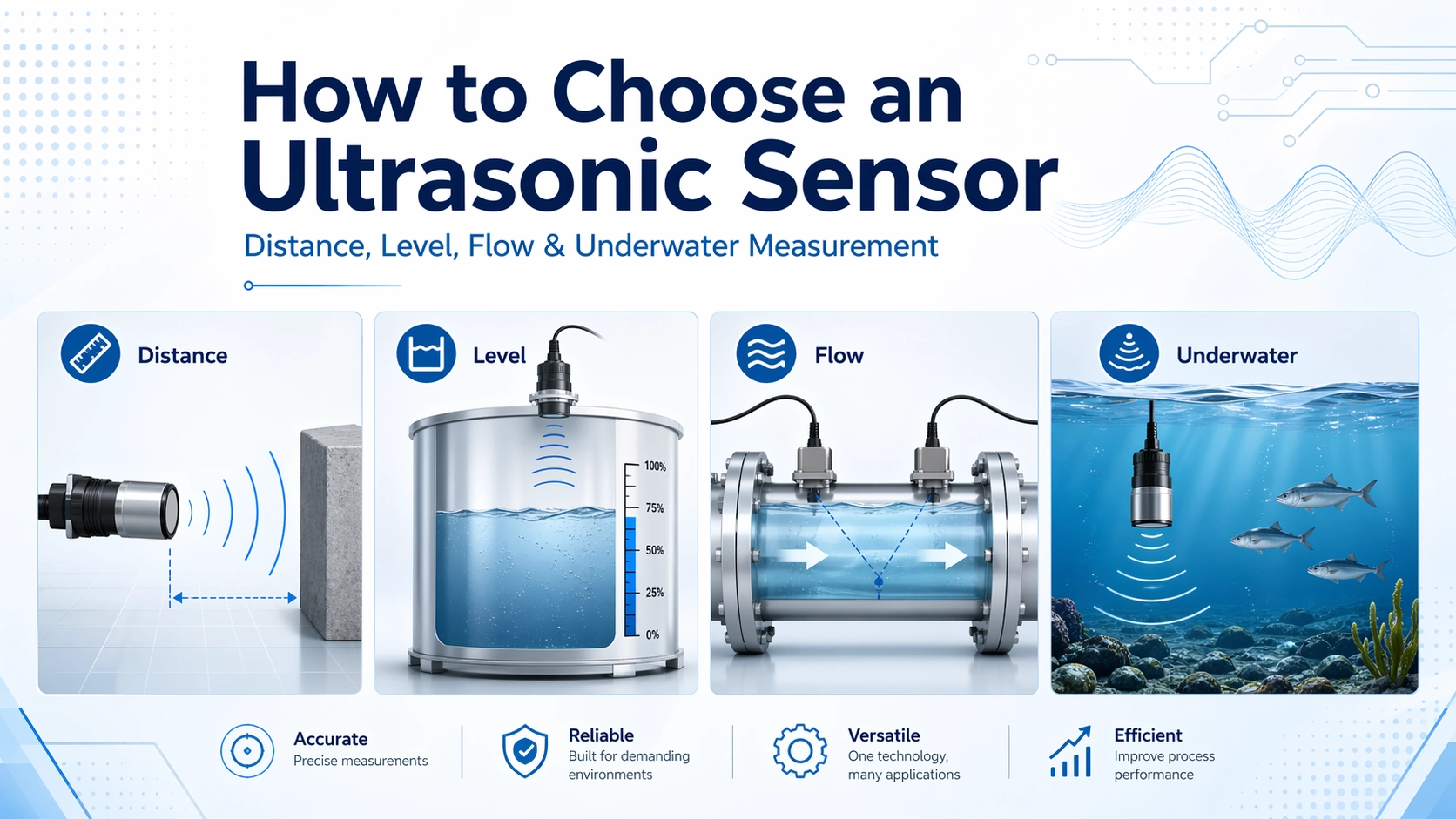
Before selecting an ultrasonic sensor, the first step is to define the application. Different applications require different acoustic designs and installation methods.
Distance Measurement
Distance measurement is one of the most common ultrasonic sensing applications. In this type of system, the sensor emits an ultrasonic pulse and receives the echo reflected by the target. The distance is calculated from the time it takes for the signal to return.
Ultrasonic distance sensors are often used in parking assistance, robotics, industrial automation, object detection, obstacle avoidance, and positioning systems. For air-based distance measurement, common design factors include detection range, target surface, beam angle, operating temperature, and background noise.
Liquid Level Measurement
Ultrasonic level sensors are used to measure the height of liquids or bulk materials without direct contact. The sensor is usually mounted above the liquid surface and measures the distance between the sensor and the surface. The level can then be calculated according to the tank height.
Level measurement applications may involve water tanks, chemical containers, wastewater systems, open channels, storage tanks, and industrial process equipment. In these cases, the sensor must be selected according to tank size, liquid type, vapor conditions, foam, turbulence, mounting position, and required accuracy.
Flow Measurement
Ultrasonic flow measurement is commonly used in water meters, heat meters, gas meters, clamp-on flow meters, and industrial flow monitoring systems. Many ultrasonic flow meters use transit-time measurement, where ultrasonic signals are transmitted with and against the flow direction. The time difference between the two signal paths is used to calculate flow velocity.
Flow applications require careful selection of transducer frequency, pipe size compatibility, mounting structure, signal stability, coupling method, temperature range, and output interface. For water, heat, gas, and industrial flow systems, sensor consistency and long-term reliability are especially important.
Underwater Acoustic Detection
Underwater ultrasonic and acoustic sensors are designed for use in water or other liquid environments. They are used for underwater detection, acoustic monitoring, hydroacoustic sensing, depth measurement, and scientific research applications.
Compared with air-based ultrasonic sensors, underwater acoustic sensors need different acoustic impedance matching, sealing structures, housing materials, and corrosion resistance. Frequency selection is also closely related to detection distance, signal attenuation, sensitivity, and target resolution.
Medical and Industrial Probes
Ultrasonic probes are used in both industrial and medical-related applications. Industrial probes may be used for non-destructive testing, thickness measurement, material inspection, and process monitoring. Medical probes require different acoustic, ergonomic, and regulatory considerations depending on the final application.
For probe applications, engineers usually need to consider center frequency, bandwidth, sensitivity, beam focus, element structure, cable design, connector type, housing design, and matching layer performance.
Key Factors When Choosing an Ultrasonic Sensor
Operating Frequency
Operating frequency is one of the most important parameters in ultrasonic sensor selection. In general, lower-frequency ultrasonic sensors are better suited for longer detection distances and stronger penetration, while higher-frequency sensors can provide better resolution over shorter ranges.
For example, air-based distance sensors often use frequencies such as 40 kHz, 50 kHz, 75 kHz, 125 kHz, or 200 kHz depending on the required range and target size. Flow measurement transducers may use hundreds of kilohertz or megahertz-level frequencies depending on pipe diameter and fluid conditions. Underwater sensors may use a wide frequency range depending on acoustic detection requirements.
Measurement Range
The required measurement range directly affects sensor selection. A sensor designed for short-range object detection may not be suitable for long-range level measurement or underwater sensing. Longer ranges usually require stronger acoustic output, suitable beam control, lower signal attenuation, and stable echo detection.
When defining measurement range, it is important to specify both the minimum and maximum detection distance. The minimum range is affected by the sensor’s blind zone, while the maximum range depends on signal strength, target reflectivity, medium attenuation, and environmental noise.
Measurement Medium
The medium through which ultrasonic waves travel is another critical factor. Ultrasonic waves behave differently in air, water, liquid, gas, and solid materials. A sensor designed for air-based measurement cannot automatically be used for underwater detection, and a flow meter transducer must be matched to pipe and fluid conditions.
For air applications, temperature compensation and environmental noise may be important. For liquid applications, sealing, corrosion resistance, and acoustic coupling become more important. For gas flow measurement, signal attenuation and acoustic path design need careful evaluation.
Beam Angle and Directivity
Beam angle determines how widely the ultrasonic signal spreads. A narrow beam is useful when the target area is specific or when interference from nearby objects must be reduced. A wider beam may be useful for detecting larger areas but may also increase the chance of unwanted echoes.
For level measurement, beam angle should match the tank geometry and avoid internal structures such as ladders, walls, pipes, or agitators. For distance measurement, beam angle should be selected based on target size and detection environment. For underwater detection, directivity affects acoustic coverage and detection performance.
Housing Material and Environmental Protection
The sensor housing must match the operating environment. Industrial ultrasonic sensors may be exposed to dust, moisture, temperature changes, vibration, chemicals, or outdoor conditions. Underwater sensors require reliable sealing and corrosion-resistant materials.
Common housing considerations include metal or plastic construction, waterproof rating, chemical compatibility, pressure resistance, cable sealing, connector design, and long-term environmental durability.
Output Signal and System Integration
Ultrasonic sensors and modules may provide different output signals depending on the system design. Common options include analog signals, digital output, pulse output, UART, RS485, Modbus, LoRa, NB-IoT, or customized interfaces.
For OEM/ODM projects, integration requirements should be confirmed early. This includes power supply, communication protocol, sampling frequency, mechanical mounting, cable length, connector type, housing structure, and firmware requirements.
Common Frequency Ranges and Typical Applications
The following table provides a general reference for ultrasonic sensor frequency selection. The final choice should always be evaluated according to the measurement environment, target material, required accuracy, and product structure.
| Frequency Range | Typical Applications | General Characteristics |
|---|---|---|
| 20 kHz – 50 kHz | Longer-range distance measurement, obstacle detection, parking sensors, industrial sensing | Longer range, wider beam, lower resolution compared with higher frequencies |
| 50 kHz – 200 kHz | Distance measurement, level measurement, object detection, industrial automation | Balanced range and resolution for many air-based applications |
| 200 kHz – 500 kHz | Depth measurement, level sensing, short-to-medium range industrial measurement | Improved resolution, suitable for selected measurement applications |
| 500 kHz – 2 MHz | Flow measurement, liquid measurement, high-resolution sensing | Higher resolution, often used in fluid and pipe-related measurement systems |
| Low kHz to high kHz underwater ranges | Underwater acoustic detection, hydroacoustic sensing, monitoring systems | Frequency depends strongly on detection distance, sensitivity, and underwater attenuation |
Ultrasonic Sensor Selection Table by Application
| Application | Key Selection Factors | Common Sensor Considerations |
|---|---|---|
| Distance Measurement | Range, target size, beam angle, response time, temperature compensation | Air ultrasonic transducer or sensor module with suitable frequency and detection angle |
| Liquid Level Measurement | Tank height, liquid surface condition, foam, vapor, mounting position | Non-contact ultrasonic level sensor or level meter with proper blind zone and beam control |
| Flow Measurement | Pipe diameter, fluid type, temperature, pressure, signal path, mounting method | Transit-time ultrasonic transducers, clamp-on flow sensors, or integrated flow meter systems |
| Underwater Detection | Water depth, detection distance, sensitivity, frequency, sealing, corrosion resistance | Underwater acoustic sensor or hydroacoustic transducer with sealed housing |
| Industrial Probe Applications | Material type, inspection depth, frequency, bandwidth, sensitivity, connector design | Customized ultrasonic probe or transducer assembly |
Standard Product or Custom Ultrasonic Sensor?
A standard ultrasonic sensor is usually suitable when the required frequency, range, housing, output signal, and installation method are already available. Standard products can reduce development time and simplify procurement, especially for common applications such as distance measurement, level measurement, and flow monitoring.
A custom ultrasonic sensor may be required when the project involves special mechanical dimensions, unusual frequency requirements, limited installation space, harsh environmental conditions, unique communication interfaces, or specific acoustic performance targets. Customization may include transducer frequency, housing material, beam angle, cable length, connector type, waterproof structure, output signal, or complete sensor module design.
For projects that require component-level selection, you can start by reviewing available ultrasonic transducers and comparing their frequency, structure, and intended applications.
Selection Guide for Distance Measurement Sensors
For distance measurement, the first step is to define the target object and required detection range. Large, flat, and hard surfaces usually provide stronger echoes, while soft, angled, narrow, or irregular targets may reduce signal strength. The sensor should be selected with enough acoustic output and sensitivity for the actual target condition.
The installation environment also matters. If the sensor is used outdoors, in a dusty factory, or near moving machinery, environmental protection and noise resistance become more important. If the sensor is used in a compact system, beam angle and blind zone should be carefully checked to avoid false echoes from nearby structures.
For parking assistance, robotics, automation, and obstacle detection, common requirements include fast response, stable echo detection, compact size, and reliable operation over temperature changes.
Selection Guide for Level Measurement Sensors
For level measurement, the most important parameters include tank height, measuring range, blind zone, liquid surface condition, and mounting position. The sensor should be installed where the acoustic beam can reach the liquid surface without obstruction.
Foam, vapor, turbulence, and angled surfaces may affect echo quality. In these cases, a suitable beam angle, signal processing method, and mounting position can improve measurement stability. For open channels and wastewater systems, environmental protection and long-term reliability should also be considered.
If the project involves a complete measuring device rather than only a sensing element, it may be more suitable to review ultrasonic meters and systems for level, flow, water, heat, and gas measurement applications.
Selection Guide for Flow Measurement Sensors
Flow measurement applications require a close match between the ultrasonic transducer, pipe size, fluid type, and measuring method. Transit-time flow meters usually require stable signal transmission between upstream and downstream paths. The sensor frequency and structure must be selected according to the pipe diameter, wall material, fluid characteristics, and required accuracy.
Clamp-on flow meters, insertion flow meters, water meters, heat meters, and gas meters may all use ultrasonic measurement principles, but their mechanical structures and signal designs are different. For example, a small water meter transducer and a large-diameter clamp-on flow meter transducer require different acoustic paths, housings, and signal processing approaches.
When selecting a flow measurement sensor, engineers should define the pipe size, flow range, fluid type, temperature, pressure, installation method, and required communication interface before final evaluation.
Selection Guide for Underwater Acoustic Sensors
Underwater acoustic sensing requires different design considerations from air-based ultrasonic measurement. Water has different acoustic transmission properties, so sensor frequency, sensitivity, sealing method, and housing structure must be selected according to the intended underwater environment.
For underwater detection and monitoring, lower frequencies are often used when longer detection distances are needed, while higher frequencies may be selected for better resolution over shorter ranges. The actual choice depends on target size, water conditions, background noise, detection distance, and system sensitivity requirements.
For hydroacoustic or underwater monitoring projects, specialized underwater acoustic sensors should be considered instead of general air ultrasonic sensors.
Technical Information to Prepare Before Requesting a Recommendation
To select the most suitable ultrasonic sensor, it is helpful to prepare the following technical information before requesting a recommendation:
- Application type: distance, level, flow, underwater detection, probe, or custom sensing
- Measurement medium: air, water, liquid, gas, or solid material
- Required measurement range and blind zone limitation
- Target object or measured material
- Operating frequency preference, if known
- Required beam angle or detection area
- Installation method and available mounting space
- Operating temperature, pressure, humidity, and environmental conditions
- Housing material and waterproof or corrosion-resistance requirements
- Output signal, communication interface, and power supply
- Quantity requirement and whether OEM/ODM customization is needed
Useful External References
For readers who want to understand the basic scientific principle behind ultrasonic measurement, the reference page on ultrasound provides a general introduction to sound waves above the audible frequency range. For inspection-related applications, the page on ultrasonic testing provides background information about how ultrasonic waves are used for material evaluation and non-destructive testing.
OEM/ODM Support for Ultrasonic Sensor Projects
Many industrial and scientific projects cannot be solved by a standard sensor alone. The final product may require a customized transducer, a specific housing structure, a special cable or connector, firmware adjustment, signal processing support, or integration into a complete measuring instrument.
In OEM/ODM projects, early technical communication is important. The sensor supplier should understand not only the target measurement range but also the application environment, installation restrictions, signal interface, production quantity, and long-term reliability requirements.
A suitable ultrasonic sensor solution should balance acoustic performance, mechanical design, electrical compatibility, production feasibility, and cost. This is especially important for industrial meters, smart sensing modules, underwater detection devices, and custom measurement systems.
Conclusion
Selecting an ultrasonic sensor requires a clear understanding of the application, measurement medium, frequency range, detection distance, beam angle, housing design, output signal, and environmental conditions. A sensor that works well for distance measurement may not be suitable for flow metering, underwater detection, or level measurement.
For standard applications, existing ultrasonic transducers, sensors, and meters may provide a fast and reliable solution. For projects with special dimensions, harsh environments, unique signal requirements, or customized acoustic performance targets, an OEM/ODM ultrasonic sensor solution may be more appropriate.
By defining the measurement requirements early and matching the sensor to the real operating conditions, engineers and buyers can improve measurement stability, reduce integration risks, and shorten product development time.