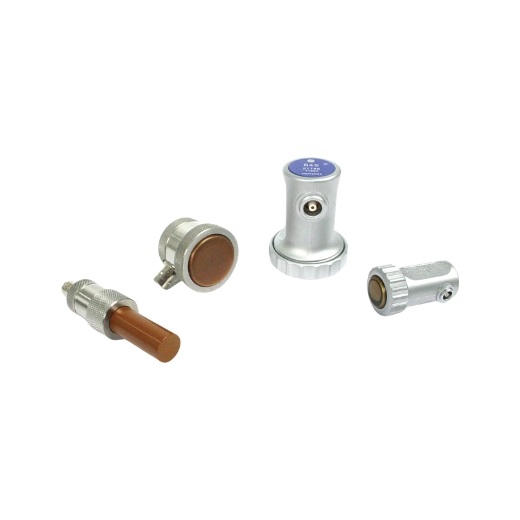
Product Overview
The protective face straight beam contact transducer is an ultrasonic NDT probe series for contact inspection and flaw detection. It is used as a front-end ultrasonic component with compatible ultrasonic flaw detection equipment, not as a complete stand-alone inspection instrument.
This straight beam contact transducer is used for general-purpose inspection of larger parts with simple geometry. Typical inspection targets include forgings, billets, plates, bars, square profiles, containers, machine components, and shells. Selected configurations support protective membrane, wear cap, or high-temperature delay line options for different contact inspection conditions.
Key Features
- Straight beam contact transducer structure for ultrasonic flaw detection and sizing.
- Protective face configuration for direct contact inspection.
- Membrane option helps coupling on uneven or curved contact surfaces.
- Wear cap option is available for selected protective face configurations.
- High-temperature delay line option enables inspection on surfaces up to 400°F or 200°C, with a maximum contact time of 10 seconds.
- Connector options include Lemo 1, Lemo 00, and BNC depending on model family.
- Side mount and top mount connector configurations are available depending on model type.
- Custom configurations are available on request.
Applications
This protective face straight beam contact transducer is suitable for contact ultrasonic inspection of larger parts with simple or regular geometry. It can be used for forgings, billets, plates, bars, square profiles, containers, machine components, and shells.
For elevated surface temperature inspection, selected configurations can be paired with a high-temperature delay line. The high-temperature delay line option is rated up to 400°F or 200°C with a maximum contact time of 10 seconds, and it must cool to ambient temperature before reuse.
Protective Face Options
- Protective membrane: Used to improve coupling on uneven or curved surfaces.
- Wear cap: Used as a replaceable protective face option on selected configurations.
- High-temperature delay line: Used for contact inspection on heated surfaces within the stated temperature and contact-time limits.
- Protective face kits: PM, PWC, and PHTD kit styles are available for selected PFCR and PFCS configurations.
Specifications
| Item | Specification |
|---|---|
| Product Type | Protective face straight beam contact transducer |
| Inspection Method | Contact ultrasonic inspection |
| Application Category | NDT and flaw detection |
| Model Families | B..S, MB..S, PFCR, and PFCS |
| Element Diameter Options | 10 mm, 13 mm, 19 mm, 24 mm, and 25 mm depending on model family |
| Frequency Options | 1 MHz, 2 MHz, 2.25 MHz, 3.5 MHz, 4 MHz, and 5 MHz depending on model family |
| Connector Options | Lemo 1, Lemo 00, and BNC depending on model family |
| Connector Mounting | Side mount and top mount options depending on model type |
| Protective Face Options | Membrane, wear cap, and high-temperature delay line depending on configuration |
| High-Temperature Delay Line | Up to 400°F or 200°C, maximum contact time 10 seconds, cool to ambient before reuse |
| Accessories | Protective membranes, delay lines, wear caps, BNC cable, couplant, and probe cables depending on configuration |
| Custom Configuration | Available on request |
Model Options
| Model Family | Frequency Options | Element Size | Connector / Mounting |
|---|---|---|---|
| B..S | 1 MHz, 2 MHz, 4 MHz, 5 MHz | 24 mm | Lemo 1; side mount standard, top mount optional |
| MB..S | 2 MHz, 4 MHz, 5 MHz | 10 mm | Lemo 00; side mount standard, top mount optional |
| PFCR | 1.0 MHz, 2.25 MHz, 3.5 MHz, 5.0 MHz | 13 mm, 19 mm, 25 mm | Side mount BNC |
| PFCS | 1.0 MHz, 2.25 MHz, 3.5 MHz, 5.0 MHz | 13 mm, 19 mm, 25 mm | Top mount BNC |
Integration Notes
This transducer should be selected according to frequency, element diameter, connector type, connector mounting direction, protective face option, and inspection temperature condition. It requires compatible ultrasonic inspection equipment and suitable contact coupling.