Blog

Ultrasonic Water Meter vs Mechanical Water Meter: Key Differences and Selection Guide

2026-04-30

Ultrasonic water meter vs mechanical water meter comparison for smart water metering applications

Introduction

Choosing between an ultrasonic water meter and a mechanical water meter is an important decision for residential, commercial, municipal, and industrial water management projects. While mechanical meters have been widely used for many years, smart water networks increasingly require higher measurement stability, remote reading, leak monitoring, and lower long-term maintenance.

This guide compares ultrasonic and mechanical water meters from the perspective of working principle, accuracy, pressure loss, maintenance, communication options, and project suitability. It is designed to help water utilities, system integrators, property developers, and OEM/ODM buyers select the right metering solution for modern smart water management.

What Is a Mechanical Water Meter?

A mechanical water meter measures water consumption through moving components inside the flow channel. Depending on the design, the water flow may drive an impeller, piston, turbine, or other mechanical measuring structure. The movement is then converted into a volume reading displayed on the meter register.

Mechanical meters are commonly used because they are familiar, cost-effective, and widely available. However, because the measurement depends on physical movement, long-term wear, impurities in water, scaling, and low-flow performance can affect measurement stability over time.

What Is an Ultrasonic Water Meter?

An ultrasonic water meter measures flow by using ultrasonic signals instead of mechanical moving parts. In many smart metering applications, the meter uses the transit-time principle: ultrasonic signals travel both with and against the direction of water flow, and the time difference between the two signal paths is used to calculate flow velocity and water volume.

Because there are no rotating parts in the flow channel, an ultrasonic meter can reduce mechanical wear, maintain a smoother flow path, and support digital functions such as remote reading, data reporting, abnormal consumption alerts, and smart water platform integration.

For example, Deep-Minds provides a DN15 ultrasonic drinking water meter with NB-IoT and CAT.1 communication for direct drinking water and clean water metering applications.

Ultrasonic Water Meter vs Mechanical Water Meter: Key Differences

1. Measurement Principle

The main difference is how the meter detects flow. A mechanical water meter relies on physical movement created by the water stream. An ultrasonic water meter uses sound waves and electronic signal processing to calculate flow.

This difference affects not only measurement performance, but also the long-term maintenance profile of the device. For smart water projects that require stable data collection and digital integration, ultrasonic measurement is often a better match.

2. Moving Parts and Long-Term Wear

Mechanical meters contain moving components. These parts may gradually wear out, especially in applications with sediment, scale, particles, or unstable water quality. As the internal parts age, the meter may become less sensitive to low flow or require more frequent replacement.

An ultrasonic water meter has no mechanical moving parts in the measuring channel. This design helps reduce wear-related performance drift and supports longer service life in suitable clean water applications.

3. Accuracy at Low Flow Rates

Low-flow measurement is important in residential billing, leakage detection, night-flow monitoring, and water loss analysis. Mechanical meters may become less responsive at very low flow rates because a minimum force is needed to drive the moving element.

Ultrasonic technology can detect small flow changes electronically, which makes it suitable for projects where low-flow sensitivity and abnormal usage monitoring are important. For water utilities, better low-flow visibility can support more reliable consumption data and earlier leakage identification.

4. Pressure Loss

Mechanical meters usually place moving parts directly in the water path. This can create additional resistance and pressure loss. In large-scale networks, pressure loss may become an important design factor, especially when many meters are installed across a distribution system.

Ultrasonic meters can provide a smoother measuring channel because the measurement does not depend on an impeller or similar mechanical structure. This helps reduce pressure loss and can improve hydraulic performance in suitable installations.

5. Maintenance Requirements

Mechanical meters may require more attention over time due to wear, blockage, scaling, or reduced sensitivity. Maintenance can include inspection, cleaning, testing, replacement, or manual reading visits.

Ultrasonic meters are often selected for smart water metering projects because they support digital reading and reduce the need for frequent on-site data collection. When combined with wireless communication, they can help utilities and property managers lower manual reading costs.

6. Remote Reading and Smart Water Integration

Traditional mechanical meters usually require manual reading unless an additional pulse output, encoder, or communication module is added. Even then, system integration may depend on the meter structure and communication design.

A smart ultrasonic water meter can be designed with communication options such as NB-IoT, CAT.1, LoRaWAN, RS485, or M-BUS. This makes it easier to connect meters to remote reading platforms, billing systems, and smart water management software.

7. Leakage Detection and Abnormal Usage Monitoring

Leakage detection is one of the key reasons many utilities and property operators upgrade from manual meter reading to smart metering. A digital meter can support more frequent data collection, which makes it easier to identify continuous low flow, abnormal night usage, reverse flow, or unusual consumption patterns.

The U.S. EPA also highlights water efficiency and water loss management as important topics for water suppliers. Smart metering data can support better visibility across the water network and help operators respond earlier to waste or leakage events.

Comparison Table: Ultrasonic Water Meter vs Mechanical Water Meter

Comparison FactorUltrasonic Water MeterMechanical Water Meter
Measurement methodUses ultrasonic signals and electronic calculationUses moving mechanical parts driven by water flow
Moving partsNo mechanical moving parts in the measuring channelContains impeller, piston, turbine, or other moving elements
Low-flow sensitivityGood for detecting small flow changesMay be affected by mechanical friction or aging
Pressure lossGenerally lower due to smoother flow pathCan be higher because of internal mechanical components
MaintenanceLower maintenance in suitable applicationsMay require more inspection or replacement over time
Remote readingEasy to integrate with smart communication modulesUsually requires additional reading or communication devices
Typical useSmart water metering, utility networks, commercial buildings, industrial water monitoringBasic water billing and traditional metering applications

When Should You Choose an Ultrasonic Water Meter?

An ultrasonic water meter is usually a better choice when your project requires digital data, stable long-term measurement, low maintenance, and smart water network integration.

You should consider ultrasonic metering if your application includes:

  • Residential smart water meter replacement projects
  • Commercial buildings and apartment water billing
  • Municipal water supply network monitoring
  • Remote meter reading and automatic data reporting
  • Leakage alarm and abnormal consumption detection
  • Large-diameter pipe flow measurement
  • Industrial clean water measurement
  • OEM or ODM smart metering product development

For large pipe applications, Deep-Minds provides a DN50–DN500 ultrasonic meter for large-diameter water flow, which is suitable for water utilities and industrial users that require high-flow measurement and smart network integration.

When Is a Mechanical Water Meter Still Acceptable?

A mechanical meter may still be acceptable for simple applications where the budget is limited, remote reading is not required, and the operating environment is stable. For small projects that only need basic manual reading, a traditional meter may be enough.

However, if the project involves long-term water loss control, automated billing, smart city infrastructure, or large-scale meter deployment, the initial price difference should not be the only decision factor. Maintenance cost, reading efficiency, data reliability, and platform compatibility should also be considered.

Standards and Compliance Considerations

For water metering projects, buyers should evaluate not only the meter type, but also relevant metrological and technical requirements. The ISO 4064-1:2024 water meter standard specifies requirements for water meters used for cold potable water and hot water in closed conduits.

Another important reference is OIML R 49:2024 for cold potable and hot water meters, which covers metrological and technical requirements, test methods, and related report formats.

For utilities, metering accuracy and data visibility are also connected with water efficiency. The EPA water efficiency guidance for water suppliers provides useful context on water efficiency programs and supplier-side water management.

Communication Options for Smart Water Metering

A modern ultrasonic water meter is not only a measuring device. It can also be part of a connected smart water system. Different projects may require different communication options depending on installation density, network coverage, power consumption, and platform requirements.

Common communication options include:

  • NB-IoT: suitable for wide-area cellular IoT deployment and utility-level remote reading.
  • CAT.1: useful when higher cellular data reliability or broader network support is required.
  • LoRaWAN: suitable for low-power, long-range smart utility networks.
  • RS485: common in wired industrial and building automation systems.
  • M-BUS: widely used in metering applications for buildings and utility systems.

For more background on low-power wide-area utility networks, see the LoRaWAN smart utilities resource from LoRa Alliance.

How to Choose the Right Ultrasonic Water Meter

Before selecting a meter, project buyers should confirm the pipe size, flow range, water quality, pressure rating, installation environment, communication method, data platform requirements, and expected battery life.

Important selection questions include:

  • What nominal diameter is required, such as DN15, DN20, DN25, DN40, or larger?
  • Is the meter used for residential, commercial, municipal, or industrial water measurement?
  • Does the project require remote reading or only local display?
  • Which communication method is preferred: NB-IoT, CAT.1, LoRaWAN, RS485, or M-BUS?
  • Is leakage alarm or abnormal water usage detection required?
  • What protection class is needed for the installation environment?
  • Does the meter need to integrate with an existing smart water platform?
  • Are there specific metrological standards or approval requirements in the target market?

If you are comparing multiple ultrasonic instruments for different applications, you can browse the full Deep-Minds ultrasonic measurement product range.

Deep-Minds Ultrasonic Water Meter Solutions

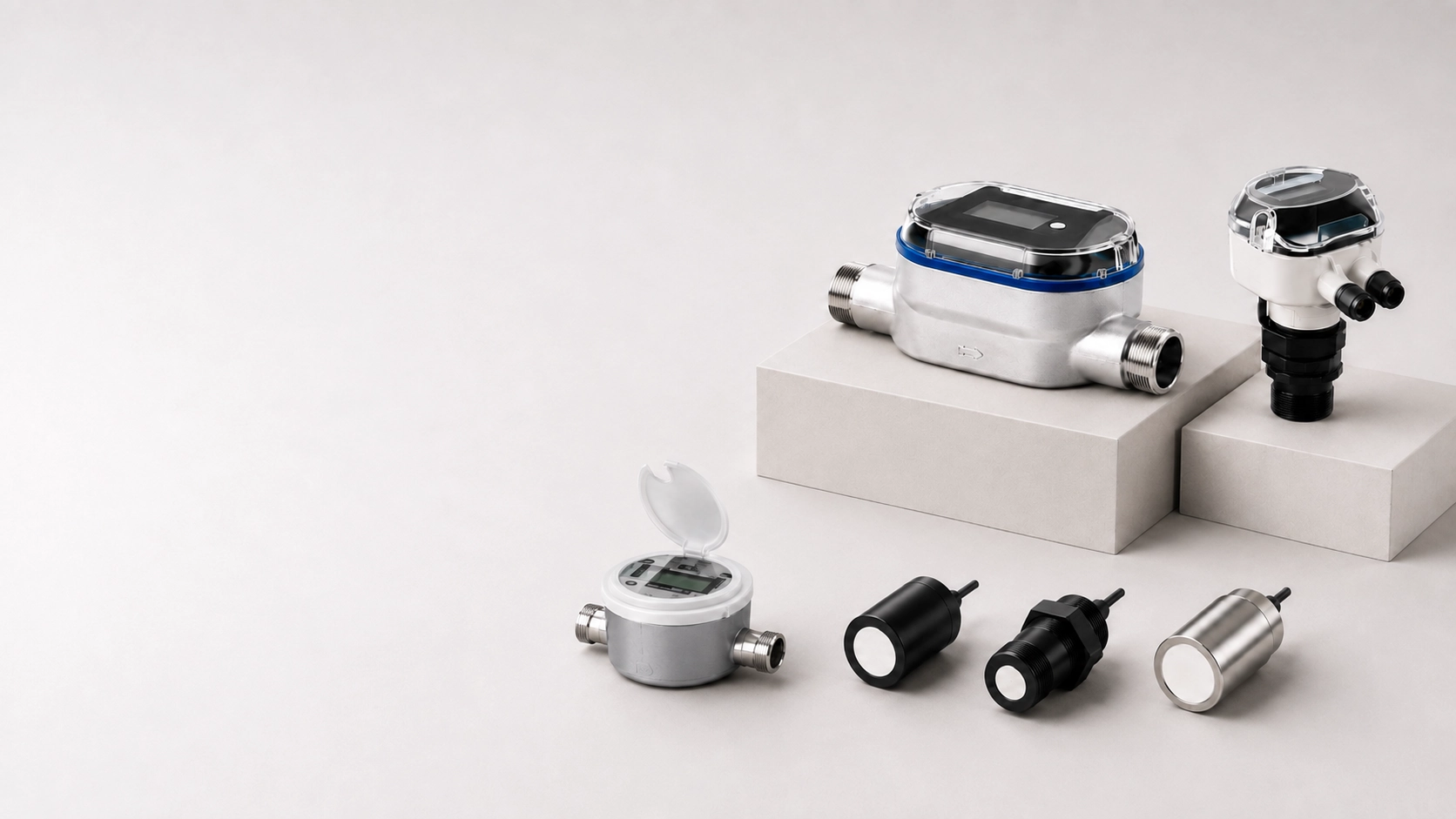
Deep-Minds develops ultrasonic measurement and sensing products for industrial and smart utility applications. For water metering projects, the product range covers compact drinking water meters, remote reading smart meters, and large-diameter ultrasonic meters for municipal and industrial water flow.

Our ultrasonic water meter solutions can support OEM/ODM customization, communication module selection, application-specific design, and integration with smart water management platforms. Whether you are upgrading a residential metering system or designing a large-scale water utility project, Deep-Minds can help you select the right ultrasonic metering solution.

To discuss your pipe size, communication requirements, target market, and project volume, contact the Deep-Minds instrument team for a water meter proposal.

FAQ

What is the main difference between an ultrasonic water meter and a mechanical water meter?

The main difference is the measurement principle. A mechanical meter uses moving parts driven by water flow, while an ultrasonic meter uses ultrasonic signals and electronic calculation to measure flow without mechanical movement in the measuring channel.

Is an ultrasonic water meter more suitable for smart water metering?

Yes. An ultrasonic water meter is usually more suitable for smart water metering because it can support digital data output, remote reading, leakage alarms, and integration with smart water management platforms.

Does an ultrasonic meter have moving parts?

An ultrasonic meter does not use mechanical moving parts in the flow channel. This helps reduce wear and supports long-term measurement stability in suitable water conditions.

Can ultrasonic water meters support remote reading?

Yes. Depending on the model and project requirements, ultrasonic water meters can support communication methods such as NB-IoT, CAT.1, LoRaWAN, RS485, and M-BUS.

Which applications are suitable for ultrasonic water meters?

They are suitable for residential smart metering, commercial buildings, municipal water networks, industrial clean water measurement, remote billing, leakage monitoring, and large-diameter water flow measurement.

How do I choose between DN15, DN40, and large-diameter ultrasonic meters?

DN15 to DN40 meters are commonly used for residential, apartment, and commercial water metering. Larger sizes such as DN50 to DN500 are more suitable for municipal pipelines, industrial water systems, and large-flow monitoring applications.